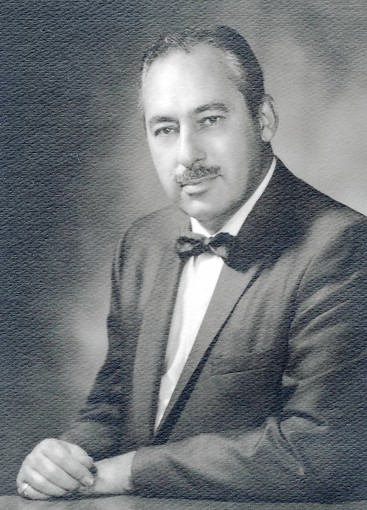
Dr. B. Ralph Hoffman
My last grandparent died this past summer.
My paternal grandfather, B. Ralph “Buddy” Hoffman, was born in 1918 in Newark, New Jersey. He went to Michigan State, where he played football, served in the Army Dental Corps and set up a dental practice in the now-hip Hampden neighborhood in Baltimore in 1949.
Poppy died in June. Going through some of his stuff, my dad found a green card for Poppy’s mother-in-law (that’s my dad’s maternal grandmother and my great-grandmother).
I never knew my great-grandmother, Rebecca Glick. She died on Thanksgiving Day in 1968, before I was born. But my Poppy, and his wife, Betty, or Gigi, who died in 2000, lived with her when they were getting their start, after Poppy got out of the Army. According to my father, Poppy had a great relationship with Rebecca. She came to live with them later, when they got their own place.
We do not know much about Poppy’s parents as they died when he was young. Gigi’s mom, Rebecca, for whom my sister is named, came to the United States in 1903 at the age of 16. (My mother’s grandmother was also named Rebecca.) She came from Latvia with her husband, William, who died young, after they had six kids together. She called my dad “sonny boy.” They owned a grocery store in Baltimore and my mom claims that Rebecca Glick used to play cards with her grandmother, Rebecca Pollack.
Rebecca does not look much like my Gigi in this picture. Nor does she look 16—I believe the green card is a reissue from 1952, which leads me to believe she never actually became a citizen. I’m trying to imagine her smiling, or me making her smile with some kind of pidgin Yiddish joke or other shenanigans. Her glasses are awesome and she looks like she’s wearing a bathrobe. I wish I could ask her about the Old Country.
People often ask me why I’m writing this book. What’s my interest. Often it’s just a curious question. Sometimes it’s asked in an accusatory way, as in: “What’s at stake for you, Hoffman (you white boy from Idaho)?” Sometimes it’s accusatory from the other side as in: “Why would you want to write about immigrants?”
Well, one reason I’m interested in the fate of immigrants to the U.S. is that my family, through our broadly and liberally defined Jewish culture, has retained some ties to the Old Country, even though we don’t really know much about the places from which our ancestors hailed (Latvia? Ukraine?). Those ties to our immigrant past allow us to be both fully American and at the same time to see the nation with fresh, sometimes oppositional, eyes. Like most late 19th century immigrant families, I can claim both my freedom of speech and assembly and my clean record on slavery, mint juleps and manifest destiny. I am a fourth generation American, taking Rebecca as the first generation, straight off the boat. But I’m no Pilgrim or Son of the American Revolution. Or Tea Partier.
The Exploring Amor and Exile Last Thursday Series, in partnership with Boise City Arts and History Department Artists in Residence Program at 8th Street Marketplace, presents A Slice of Life in Exile at 7:30 p.m. on Thursday August 25, 2011 at the Cole/Marr Coffee and Photography Workshop.
Nicole and Margarito
Amor and Exile coauthor and native New Yorker Nicole Salgado will share a slice of her life in exile in Queretaro, Mexico, where she’s lived for the past 5 years with her husband Margarito and their daughter, who was born last fall. Along with Salgado’s slice of life in exile, you will hear readings from popular blogs by other Americans in exile because of their partners’ immigration woes. Salgado will narrate a photo slideshow, share a recipe from her cookbook, The Bajio’s Bounty, and field Q&A from the audience. Join us!
Event details:
Thursday, August 25, 7:30pm – 9:00pm
The Cole/Marr Photography Workshops
404 S. 8th Street, Lower Level
Boise, ID
FREE (beverages and snacks available for purchase from our lovely hosts)
The American Immigration Lawyers Association has just released a report that documents 127 cases of immigrants who were taken into Immigration and Customs Enforcement custody after minor interactions with local law enforcement officials. This often happens through the Department of Homeland Security’s “Secure Communities” program, which has come under intense scrutiny in recent weeks. Secure Communities provides immigration authorities with fingerprints from local jails, but DHS has several other means of scanning arrestees for immigration violations including 287g, which deputizes some local police and sheriffs to enforce immigration laws and the Criminal Alien Program, which screens inmates in select jails and prisons for immigration violations.
Perhaps most chilling, however, as documented in the AILA report, is the tendency of local law enforcement, including U.S. Forest Service rangers in one example, to call in ICE after routine traffic stops and hand the case over to them.
The opposition to Secure Communities and to the large numbers of deportations under the Obama administration that the program has facilitated, is still being led by fearless undocumented youth, as evidenced by demonstrations in Chicago and Los Angeles (see YouTube video below). But as the numbers of U.S. citizens or permanent residents with close relatives and friends caught up in this federal dragnet increase, a new opportunity for protest is on the rise.
Of the 127 cases the AILA report documents, at least 27 of the immigrants in deportation proceedings have U.S. citizen or permanent resident spouses or fiances. Four are dating American citizens. And even more have U.S. citizen children, siblings and parents. Imagine for a moment that you are driving with your husband in Florida, you get a ticket and when you go to court to challenge it, your husband is arrested by ICE agents and placed in deportation proceedings:
In 2010, a man in Florida was a passenger in a car driven by his wife, a U.S. citizen, when the car was pulled over. The wife was given a ticket for driving without a license. The wife went to traffic court to challenge the ticket because she had a valid driver’s license. The man accompanied her to court. Even though the wife was a U.S. citizen, she was not fluent in English because she had spent many years outside the U.S. However, plainclothes ICE agents were at the courthouse arresting people who needed an interpreter, and they arrested both the man and his wife. He has been placed in removal proceedings and has no relief other than voluntary departure. He was the sole source of support for his wife and two U.S. citizen children. He also helped support his wife’s U.S. citizen sister and her two children. —AILA Case Study #26
These cases are occurring all over the country at all times of day and night. Even Good Samaritans and VICTIMS of crimes are being caught in the dragnet:
In September 2007, a man called the police after being the victim of a hit and run car accident in New Mexico. The sheriff’s deputy who responded to the call repeatedly asked the man if he was “illegal.” When he finally admitted to being in the country unlawfully, deputy arrested him. He was held until ICE picked him up and was eventually deported to Mexico. His lawful permanent resident wife and their U.S. citizen child moved to Mexico as well. —AILA Case Study #83
I cannot see how President Obama, a student of the 1960s Civil Rights struggle can watch this type of injustice occur, much less sit idly by as “citizens”—and I use that term in the broadest way possible, as in good citizens—take to the streets over it.
On the heels of the Rick Perry Jesus-fest in Texas, it’s nice to see some mainline Christian groups stepping up to the plate in Alabama and actually getting some press for it.
2006 Pro-immigrant march in Chicago | Edu-Tourist on FlickrAlabama took the mantle from Arizona for most regressive state immigration law in the country when it passed H.B. 56 in June. The law, which goes into effect next month unless stopped in court, contains Arizona-like provisions for police stopping “suspected illegal immigrants.” But it also goes further in forcing public schools to check the residency status of students and making it a crime to transport or harbor undocumented immigrants. The Obama administration has sued to stop implementation of the law, as have at least 16 other nations.
But the latest opposition is coming from a several mainline Christian groups: Methodists, Episcopals and Catholics have actually sued for the right to minister to people regardless of immigration status. These groups have long been supporters of comprehensive immigration reform, but stepping into the spotlight and suing the state is a good move, and reminds us that the Christian right is not the only religious group out there mixing it up in the political realm.
That reminder is important. To non-Christians such as myself, it’s easy to lump all Christians into one big group. I know that Christians have always been on the left and the right side of American history; I know that Martin Luther King, Jr. and Cesar Chavez were both Christians and I occasionally read liberal Christian journals like Sojourners. And perhaps the Christian right—the prayer breakfast, God and Country, fundamentalist right—is more amplified here in Idaho. But it seems like the Christian right is just so much louder than the Christian left. So I’m heartened to see mainstream, liberal Christians raise their voices through this lawsuit.
Maybe they could also take a hint from their non-proselytizing Jewish and Muslim brothers and start preaching to their own co-religionists on the right who have lost their way, rather than looking far and wide for new Christians?
Last week, while visiting family on the East Coast, I spent a day in Washington, D.C. I hoped to interview several congressmen about their views on mixed immigration status couples but my timing was really bad: I arrived the day after the debt ceiling vote and most lawmakers were on their way home to “brag” about their votes. But I ended up meeting with staffers in two congressional offices and I think our background conversations were even more valuable than an interview with the elected officials would have been.
Though mixed status couples have not gotten very much press compared to other groups seeking immigration relief (like DREAM Act students or same-sex couples), there are some very good ideas floating around Capitol Hill, backed by the Congressional Hispanic Caucus. The CHC and individual lawmakers have requested that the Obama Administration:
Switch to processing waivers to the 3- and 10-year bars (essentially pardons for SOME undocumented immigrants who would otherwise have a family visa available) inside the United States, rather than forcing tens of thousands of relatives of Americans to travel abroad while waiting for their applications to be processed.
Expand the definition of “extreme hardship”—the standard for getting the above-mentioned waiver—so it includes separation from a spouse, for example, or from U.S. citizen children. These seem obvious, but currently Americans have to prove that they will suffer medical or serious financial hardship for their immigrant partners to win these cases.
I also heard that the Obama administration is very sensitive to media coverage—both in English and Spanish language press—on immigration reform. Perhaps this is obvious or old news, but I was surprised by some of the examples of press determining policy that staffers offered. I have to confirm this notion further.
I also realized that Obama is about two years behind the curve in thinking on Comprehensive Immigration Reform, a tactic that many in the pro-immigrant movement abandoned in favor of individually tweaking policies that help mixed status families, students, youth, and same-sex couples. Maybe a year ago, there were still a few pro-immigrant congressman who were saying they wanted comprehensive reform or nothing. The DREAM Act activists changed their tune by successfully demanding a vote and now Obama (and other presidential candidates who do not want to take a stand) is the only one talking about comprehensive or nothing. At least many Republicans talk about specific policies like border control or mass deportations—as flawed as their logic is—rather than the vagaries or Russian Roulette of comprehensive reform.
Another view from Capitol Hill is that LGBT advocates have made better headway in working with the immigration agencies than the undocumented in part because La Migra has a built in bias against people in the country illegally, but not necessarily against same-sex couples. Of course, those groups do overlap frequently and many same-sex couples are going to need the same relief that mixed-status couples are seeking, be it in-country processing, an expanded hardship definition or a legalization program.
Walking across Capitol Hill, from the Senate office buildings to the House side, you have to pass right in back of the U.S. Capitol. I’m always struck by how small it looks from the back: the nation’s capitol is just another building really (as is the Supreme Court, which sits just off the back lawn). I’m struck by how members of Congress appear so normal looking away from the TV cameras, as they walk to lunch or to their cars, sweating just like everyone else. While the business of governing exudes a mystical, larger-than-life persona on the evening news and in the papers, it’s just regular folks there in Washington, trying to keep themselves sane and popular. It’s worth a stroll around the congressional parking lot every few years to remember that.
A friend of mine is a midwife educator and we took a few classes with her before our baby was born. In one of them, on the topic of pain, she introduced us to a great saying: FEAR is False Expectations Approaching Reality. It buoyed me at the time in the hopes that labor wouldn’t be as painful as I expected. Although I can’t say the birth of my daughter was less painful than I feared, I can say that traveling to the U.S. with her was.
There were many things that allowed my FEAR to be just that—false expectations. Some things were better than I worried they’d be, and some things were worse. But overall, it was a much more pleasant experience than I imagined—as another American friend who’s a long-timer in Mexico has suspected may be the case with me, I might be psyching myself out to be pleasantly surprised in the end. Not a typical personality characteristic of mine, but when it comes to love and exile, it can be a useful tactic.
The cost was not a problem because I did not keep track of how much money I spent like I have on other trips. Why bother? Keeping track of my receipts wouldn’t change how much I had to shell out, that I’ve been unemployed for the last 24 months, or that my financial safety net is developing some seriously large holes. In the end, I had enough to get back home.
The family reunion was a success, if you don’t count the fact that my husband wasn’t there. But then again, neither were several aunts, uncles, and cousins…so why be nit-picky? The important thing was that my daughter got to see her grandparents (my parents) again, meet her uncle (my brother) and his fiancée, her great-aunt & uncle and a couple of their relatives, a good handful of my high school friends, and a large number of my parents’ friends from work.
One unexpected dynamic was that despite his absence, Margo had a much stronger presence than past trips, and I chalk that up to him being present through our daughter. She looks a lot like him, questions directed to me about her invariably brought him up, and many people intuited how much she (and me, by default) must miss him. So it was nice not having to tiptoe around the subject of his absence like a big white elephant.
I’d done my grieving over not being able to get a Canadian visa for Margo for travel. I’d prepared myself emotionally and let loose a few floodgates en route to have the best mindset possible upon arrival. Sure, a few tense moments occurred as can happen with anyone traveling with kids and aligning parenting philosophies with the grandparents. But I was surprisingly solid when it came to not falling apart.
It might have been because I convinced myself, as I told our daughter, that there were some good things about him staying home: he had to work, we saved money, someone had to feed the chickens and the bunny and the cats and water the garden, someone had to watch the house. So when we’d make our phone calls, it felt more like he was serving a purpose back home than languishing lamenting about not being with us. That was fortunate.
I also might not have had time to grieve his absence since I was so darn busy taking care of the baby. Besides fully co-parenting with my husband, we also had someone coming in a few days a week to help with the baby for the month before we left, and so I was used to getting a large amount of help with the baby at all hours. Her grandparents were great with her, feeding, entertaining, and bathing her to everyone’s delight, but spending the nights getting up alone with her and putting her to bed during Fourth of July fireworks and the days prior were more tiring than normal.
One FEAR that was more true than I expected was the exhaustion factor of the actual bus and air travel by ourselves. But even so, it was kind of funny to see a couple in the airport with two young kids bickering over some aspect of parental care mid-escalator ride. In the state I was in, baby hanging from the sling, (albeit balanced nicely with backpack weight), with luggage in tow, I smiled knowingly at the woman and said, just breathe. She looked surprised for a moment but then smiled back at me. Then they went back to their bickering and I thought to myself, I don’t have to deal with that aspect of traveling together, even if my back is aching!
The author and her daughter at her parents' home in NY
Another silver lining to the exhaustion was that all of that extra time with the baby by myself also led to something special—we bonded like when she was a newborn, and that was perhaps the sweetest unexpected benefit of all.
When I got back to Mexico, I got some feedback from friends with children that gave me some insight about the fact that, although I may have unique circumstances as to why my husband isn’t able to travel with us, it’s surprisingly common for many of my friends to fall into the traveling alone with kids department. One friend related how her husband is stuck in the PhD program from hell for almost 10 years, which has forced her to strike out camping on her own with two small boys. A new American friend here in Mexico traveled alone with not one but two kids up to the States in June—not because her husband doesn’t qualify for a visa but because he forgot to renew it. Others travel alone because their spouses can’t get time off work.
Although I feel womanly solidarity in that we all face similar challenges with our children and I empathize with their spouses’ unavailability for travel (and I also bow down to their ability to juggle multiple infants alone!), when I mentioned this to Margo, as well as the pros of the “holding down the fort” argument, he wasn’t 100% convinced. “Yeah that’s all true, but Iwould like to go.” Knowing he’s someone who doesn’t express their wants and needs often, his words didn’t fall on deaf ears. And perhaps that is the one expectation that most disappointingly approached reality: that on the subject of traveling together as a family, reunion or otherwise, bright sides or not, ultimately we didn’t have any choice but for Daddy to stay home.






 Walking across Capitol Hill, from the Senate office buildings to the House side, you have to pass right in back of the U.S. Capitol. I’m always struck by how small it looks from the back: the nation’s capitol is just another building really (as is the Supreme Court, which sits just off the back lawn). I’m struck by how members of Congress appear so normal looking away from the TV cameras, as they walk to lunch or to their cars, sweating just like everyone else. While the business of governing exudes a mystical, larger-than-life persona on the evening news and in the papers, it’s just regular folks there in Washington, trying to keep themselves sane and popular. It’s worth a stroll around the congressional parking lot every few years to remember that.
