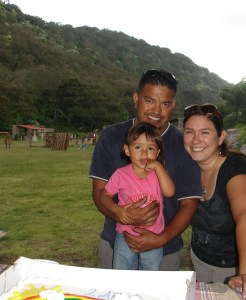
Nicole, her husband Margarito, and their daughter at her 2nd birthday party in Mexico.
For the last few months, I have been involved in the surge of political activity surrounding the ongoing debate about immigration law. I’ve been very grateful for the support of my fellow American women in exile or separated from their spouses in our Action for Family Unity working group. In further virtual “travels” through the online political organizing world, members of a particularly active group, American Families United (AFU), reached out and let us know about their wonderful work to lobby Congress to include families like ours in legislative reform. To that end, I quickly learned that AFU is working hard to pass waiver reform legislation. AFU is a volunteer-run organization with a paid lobbyist, so it depends on an active membership and annual fees in order to keep its work going forward. I’ve joined, and I urge others in our situation and our extended family members and friends who want to see us back home to also join.
Nicole and her daughter at her brother’s wedding, Margarito was unable to attend.
For those who are new to my story, this is it: I’m from Central New York, but since 2006, I’ve lived in exile in Central Mexico. My husband and I met 13 years ago near San Francisco. He was a builder, and I had recently graduated from Cornell. I knew he had an immigration record, but I was certain marriage would solve any problems he might have. In fact, my husband’s only chance for legal status was to leave the U.S. and wait 10 years to apply for reentry. Two years after we married, we moved to his hometown of Querétaro, México and can apply for a waiver in 2016. Culture shock, the economy, stress-related and local illnesses have turned my life upside down. But I also built a home, began to teach, had a baby and became a dual citizen. I coauthored the book Amor and Exile with Nathaniel Hoffman from 2011 to present. The book documents the issues faced by Americans married to undocumented immigrants. Despite all the hardships I’ve faced, I haven’t lost hope that someday we’ll obtain my husband’s legal right to join my daughter and I in the U.S., and for thousands of other families like ours to reunite in their homeland.
I think that groups like AFU are our best hope right now to get the chance to come home through this latest round of legislative debate. I can’t think of any more effective voice that is doing this type of work, specifically for our family situations. If anyone is aware of any other organizations doing this type of work, we’d love to know about them, in order to build our alliances and gain as much broad support as possible.
Our stories just keep coming out, and out, and out. The farther we come out, the more scary it feels, but it also feels so wonderful to read and hear the words of our supporters as they join the call to legislators to help bring us home.
These past two weeks have been really amazing. Just last month, I was thinking it would be hard to get families like ours (in exile or facing exile due to immigration laws) organized into a cohesive political force to be dealt with. But then I put out a call asking if anyone knew of specific organizations dedicated to lobbying for our issues. There aren’t many—our presence on the media map is very sparse, despite our large numbers. There are a wide variety of organizations doing great advocacy work and coming up with exciting solutions, too many to list here. But if you’re interested, Prerna Lal, one of my favorite immigration bloggers, suggested a list of sites to start with here.
One thing happened after another. A fellow exile blogger, Raquel Magaña, got back to me with a few ideas of people to be in touch with. The first was Ellin Jimmerson, director and producer of The Second Cooler, a moving documentary that focuses on how immigration is a human rights and workers’ rights issue (Thank you Ellin).
Next thing I knew, I was messaging like crazy with other women in exile—in the U.S., South America, Mexico, South Korea. This was nothing new for many of them—they’ve been in touch with each other for a while—a long time for some, and attracting press to put our issues on the map. But my efforts on activism have been isolated to advocacy back in 2006 (the SF marches) and getting my memoir out over the last 2 years, with the occasional petition signature, and I hadn’t been a part of any online forum before.
But I also got the sense that the call for action was burning really bright for some women. We’re supportive of the broad movements, we’re supportive of the more specific ones, like those of the DREAMers. But we’re also afraid of getting left out of upcoming reform (Some might say we’ve got a snowball’s chance in hell, but we’re going to try anyways). So suddenly, we formed a group. It has a name and plans for action and collaboration and everything. It all happened so fast. We submitted our pictures and a beautiful mosaic image of them was made. We shared our stories, some intensely personal and not for public eyes. We began building trust in the best way possible without having met our colleagues before, while making up your own rules. We did a petition.
Raquel summed it up well with this comment:
“You will find that every one of these women has a story to be told… and those stories will be told, with heart, with passion, and with the truth of how their individual rights have been overlooked. These ladies will conquer the truth in this history made in their pens and that should promote a government official to execute some relief NOW. When threatened to be overlooked, there is organization. Family unity…there are too many to ignore.”
I am totally floored by how we’re managing to collectively surf this wave of energy we all have, to DO SOMETHING on behalf of our families and others like ours. I have no idea where all this will lead. This is purely voluntary, we all have day jobs, and no financial base to grow from. But I do know that I am feeling a hell of a lot more inspired than I was a month ago, when I wasn’t sure of what I could do beyond writing my story.
I believe in the power of the critical mass. And I wouldn’t be ashamed if we didn’t “make it” this time. As I’ve said before, I’m in this for the long haul.
Most importantly, we’re coming together. For action. Which brings me back to the petition. I wrote it with the help of others and I think it’s very powerful. It sums up our goals pretty well. All the comments I’ve read by my friends, family members, people I don’t even know, bring tears of joy to my eyes. And we hope it will continue to get signed like crazy. Help our group out with that, would you? And stay posted, as this probably won’t be the last thing you’ll hear about it.
People have been asking me if I saw Obama’s inaugural speech. I probably should, just to be “informed.” My not having seen it has less to do with me being a cynic than my not wanting to be let down again. Ever since his victory speech in 2008, I’ve been riding a hot air balloon with a slow leak.
Today, idealistic feet planted fully on the ground, even with rumors of impending immigration reform, I prefer not to entertain illusions of quick fixes to my family’s problem of a 10-year exile in Central Mexico. Even so, I just don’t have the heart to reveal the full extent of my reservations to my 90-year old grandmother. Her grandparents were immigrants from Germany, settling to farm in Central New York, much in the same way my father’s side of the family immigrated from Mexico a couple generations ago.
Last week my grandmother told me she really wanted to read our book. I wish I could snap my fingers and a publisher would pick it up this week. More than giving her the satisfaction of reading her favorite granddaughter’s story, it would help explain the tangled tale of why whatever immigration reform the administration is plotting probably won’t benefit my family and me.
The author and her grandmother “GG”
Last night, she asked me about the inaugural speech. Did I see it? It was great. I told her no, that I’d rather just hear about the new laws getting passed than getting my hopes dashed again. That I wish he would stand up to corporations trying to milk our country dry of every last taxpayer dollar. I’d much prefer to hear about new initiatives passed investing in solar power than hear that Keystone XL is getting new rein in the Lower 48. But when she told me she wanted to send a letter to our senator, Chuck Schumer, I thought to myself, what could Chuck do at this point? We’re not a Dreamer in a university town with several thousand signatures behind us. We’re an unlikely unit of three: one Mexican man with a junior-high education who just wants to have meaningful work, one Ivy-League educated thirty-something, years away from her career and a toddler who might never go to school in her second country of citizenship. But I kept silent, because who am I to knock a great-grandmother’s undying optimism?
I share my grandmother’s hope, and the hope of millions: I want meaningful immigration laws passed, the kind that would allow my husband, daughter and me to return home to the U.S. together as a family. I’d rather see this happen than hearing for the umpteenth time that immigration reform is in the news, or surmise that Latinos are simply pawns in another political game. Our story is a part of the book Amor and Exile because I wanted to share our voice and illustrate an incredibly complex subject in that way that only a personal tale can. In the event that we cannot get our book to the public before the immigration reform debate happens, I’ll need to find another way to contribute to this debate.
But I’ll admit, I’m struggling to figure out how to do more than what I’ve already done. Championing immigration reform is a bittersweet battle for me. Although millions of youth and families like ours—and the U.S. economy—stand to benefit from immigration reform, because our family is suffering from a draconian time bar, the likelihood that we will benefit is very slim.
Of course I do allow opportunities for inspiration. I listened to part of that speech today, to Richard Blanco’s inaugural poem. His message of unity, of vision beyond the things that separate us struck a chord of kinship in me, even released some tears to cleanse my eyes that are frankly too young to be so chronically pessimistic. With this choice of poet, with this message of hope, I look forward to some choice actions taking the place of choice words on Capitol Hill this year. And in listening to this poet’s work, I am inspired to rise to the challenge of communicating exactly why it is that I can’t go home, and how, in an ideal world, my fellow citizens could help get me back there. I’ve always been a willing soldier of idealism, and I know there is a lot of work to do.
Maybe if I get to go back home to the U.S. with my family as a result of this next presidential term, I will watch that inaugural speech after all.
Six years ago, ten years felt like an eternity. Our waiting period. Ten years, and then a request for a “pardon” and a shot at a visa application for my husband. Every year I returned to the States, alone, every time, feeling so sad about having to leave my husband in Mexico. Our hopes are about so much more than a visa. Our hopes are about keeping our family together. For me, having to travel alone for 6 years meant it started to affect me a little less every year than the first time.
Now, on this seventh trip back (one year I went twice), my husband’s the one with tears in his eyes. For the record, I’ve seen Margo with tears in his eyes maybe three times in the eleven years I’ve known him. This time, it was at dinner. Tomorrow, he bids me and his toddler goodbye for three weeks while she accompanies me as a bridesmaid in my friend’s wedding in CA, and my grandmother’s 90th birthday in NY. It’s perhaps not as traumatic a separation as some families experiences when a parent is deported or jailed, but it hurts all the same. I tried to reassure him that we’d call twice a day, and we’d be in good hands, and I’d be as patient as possible with our daughter in his absence (he’s the good cop), but that wasn’t what was upsetting him. “I know, but it’s just frustrating,” Margo said “it’s difficult.”
I started to tear up myself in realizing just how rough this was going to feel for my husband this time around. But then he remembered the one beer I bought him earlier and the mini bottle of wine I got myself a couple days ago. “I want to be able to celebrate the night before we go,” I had said. “Se me estaba pasando,” Margo said, almost forgetting. We poured a glass and I reminded him of the possibility that when 2016 comes we might actually get lucky. “The first lawyer was a lying optimist, the second and third lawyers were truth-telling pessimists, so maybe this fourth lawyer is a truth-telling optimist,” I said, regarding some recent encouraging legal advice we’d heard about our case.
He managed a half-smile, and we toasted. “To 6 down, and 4 to go,” I said. Que sera asi.
The Obama Administration announcement last week that it wants to allow some mixed immigration status families to remain together in the United States while they apply for hardship waivers was briefly turned into media debate fodder and then, apparently dropped because it is just too difficult to explain. But the few conservatives who cried foul, including Texas Republican Lamar Smith who wrote the 3- and 10-year bars into law in 1996, have very little ground to stand on here. As I reported last week, it has been in the works for a long time, it’s highly technical, it’s been suggested by multiple government and NGO reviews of the waiver process, it does not change any laws and it does not provide any new benefits for undocumented immigrants.
Houston immigration attorney Laurel Scott, who has written extensively about waivers, said the proposed rule actually improves compliance with the law. The waivers were originally intended to prevent the hardship of family separation, she said, and the proposed process would minimize the time that immigrant spouses and children of American citizens must spend abroad.
Still, the timing of the announcement and its provenance from the White House is clearly political and the pundits briefly made hay from this latest administrative decree. The moment in this news clip when CNN anchor Erin Burnett asserts to former American Immigration Lawyers Association president David Leopold that anyone who legitimately marries an American citizen can get a green card (then looks down, bites lip, blinks) highlights a huge problem for advocates of immigration reform.
Watch the clip at 2:12 for that moment:
Kris Kobach, the Kansas Secretary of State and crusading attorney who helped draft anti-immigrant legislation in Arizona and for state legislators across the country, skillfully puts the onus back on “illegal aliens, whether they decide to marry a U.S. citizen or not.” And Leopold is not quite able to counter what Moderator Burnett declares to be quite rational.
If the news that the Customs and Immigration Service will now process some “family unity” or family immigration waivers stateside accomplishes one thing, it should demonstrate to the American public once and for all that hundreds of thousands of American citizens have been living in the shadows with their undocumented spouses for the past decade.
Here’s the weird thing: Burnett is mostly right. Immigrants who marry U.S. citizens ARE generally eligible for a green card. Our national immigration system remains, technically, family friendly. BUT if they are in the United States illegally or face any of more than 60 different “inadmissibilities,” that green card may remain just out of reach.
There has been a lot of talkabout this “catch-22” in the past week. USCIS puts it this way in the rule notice:The action required to regularize the status of an alien, departure from the United States, therefore is the very action that triggers the section 212(a)(9)(B)(i) inadmissibility that bars that alien from obtaining the immigrant visa.
Here it is in plain English: In order for an immigrant who entered the country illegally and then married an American citizen to get a green card, he or she has to leave the United States. But leaving triggers, in most cases, a 10-year ban (that Congress approved in 1996). To salve this catch-22, Congress crafted a series of pardons, or waivers, available for many, but they are complicated and time consuming and a bit risky to get. Applicants must show that if they are not granted a visa, their American citizen spouse or parent will suffer “extreme hardship.” Three quarters of the immigrants seeking waivers to enter the United States are from Mexico and require a visit to Ciudad Juarez, Mexico; I traveled there last January to see the process first hand.
Because these waivers are difficult to understand and a major financial and emotional and legal burden for many of the couples who need them the most, many, many couples choose to stay in the US, under the radar, rather than applying for green cards and facing the ban and subsequent waiver process.
Enter Candidate Obama. The USCIS is now proposing a tiny tweak in the process that could reassure many couples. They will be able to apply for the pardon BEFORE they leave the US to pick up their visa. This proposed rule (at this point it is still a notice of intent to publish a proposed rule) would provide provisional waivers to some couples so that when they return to the US Consulate or Embassy in their home country, they will be able to get the visa more quickly and efficiently and in fewer steps.
There are lots of waivers for lots of different violations. This rule change would apply to a VERY limited set: only people who “entered without inspection” and have a US citizen spouse or parent could get the provisional waiver. So if your fiancé is a citizen, you have to get married first and if your mom is a permanent resident, you won’t qualify for a provisional waiver.
Also, if you are like Nicole, whose husband has a permanent ban, and who is already living abroad, you won’t qualify. Bear in mind that the difference between a 3 year, 10 year and permanent ban is not that great. If you have been here illegally for 6-12 months, you get a 3-year-bar and if it’s more than a year you are barred for 10 years. In both cases you would be able to utilize the new provisional waiver before leaving the US to get an immigrant visa. But if you entered the US twice, say, after a trip home to see a sick grandparent or even to introduce your wife and kids to your family—even if not caught—you are banned permanently without an opportunity for a waiver. (In the case of this permanent bar, an immigrant may be able to reapply after waiting 10 years abroad, but only a few people have to tested this procedure to date.)
It is impossible to know how many couples in the US are currently eligible for a waiver of some type. Minneapolis immigration attorney Michael Davis said today that he’s gotten dozens of calls in the past week but many of the couples inquiring face a permanent ban and so the provisional waiver would not help them. Still, Davis thinks that processing the waivers in the US will encourage many couples to apply, once the new rule is finalized, which is supposed to be by the end of the year.
“I think it’s going to be an incentive for a lot of people to come out and do it,” he said.
In FY2011, USCIS received 23,262 I-601 waiver applications and approved 17,790, roughly a 76 percent approval rate. The approval rate in Ciudad Juarez was closer to 90 percent last year, according to a USCIS spokesman. More than 100,000 people have applied for waivers since 2006. But there are many more people out there who are unaware of the benefit or have been unwilling to take the risk and expense of applying.
One question that remains is what will happen to applicants who are denied a provisional waiver. They will still be in the United States without papers. On a USCIS stakeholders call yesterday, immigration officials did not answer this question, instead seeking suggestions from the public, but an FAQ on the USCIS site does adress the issue:
Q. What would happen to individuals who are denied waivers under the proposed process?
A.They would be subject to USCIS guidance and law enforcement priorities for issuing Notices to Appear (NTA). For example, convicted criminals, public safety threats, and those suspected of fraud will receive NTAs.
In other words, many of the people denied, if not priority cases for ICE, would just be back to square one—undocumented and married to Americans. But at least they would be with their families in the States rather than separated or forced to move under duress. Going into 10 months of political campaigning, I am glad that Obama is at least signaling a willingness to discuss the deep relationships that Americans have with the undocumented population. While families and family values are a fine starting point, I continue to hope that the candidates will examine their own relationships with migrants, with Mexico in particular and with our national stake in immigration reform.
Waiting room at the U.S. Consulate in Ciudad Juarez
After a year or more of quiet planning, the Obama Administration will announce today that it intends to process immigrant hardship waivers within the U.S., allowing many more undocumented immigrants with U.S. citizen spouses and parents to apply without risking the immigration bars that have plagued hundreds of thousands of families since 1997.
Julia Preston at the New York Times broke the story early Friday morning, quoting Alejandro Mayorkas, director of U.S. Citizenship and Immigration Services, the agency that handles waiver requests: “The goal is to substantially reduce the time that the U.S. citizen is separated from the spouse or child when that separation would yield an extreme hardship.”
The changes are not immediate and will have to undergo a year-long rule making process, according to the Times. They may also be subject to significant political and Congressional push back during the coming year.
The waiver process has been a major element of my reporting for Amor and Exile, and I have been hearing hints of this change for about a year now, though the Administration kept it under tight wraps. In January 2011, I visited the U.S. Consulate in Ciudad Juarez, Mexico where 75 percent of all of these waivers are processed and officials there hinted that USCIS was working on a plan to consolidate some of its international operations within the United States.
More recently I learned that things had been changing in Juarez since I visited a year ago. Much of the USCIS staff had left for posts in the U.S. and immigration attorneys in the U.S. were noticing the wait times growing and some degree of disorganization in processing hardship waivers. USCIS announced a conference call on October 14 to explain a new procedure for people wishing to file their I-601s, or hardship waivers, in which they would send the application to a service center in the United States rather than filing at a foreign consulate or embassy. But on the same afternoon that it was scheduled, the conference call was suddenly canceled, even as attorneys waited for the call to begin. It was never rescheduled.
The expected announcement Friday in the Federal Register signals the administration’s intention to allow immigrants to apply for the I-601 hardship waiver from within the United States, rather than forcing them to leave the country first, which triggers 3-year, 10-year and even permanent bars from re-entering, and presents a high risk for many families who may otherwise qualify. The new policy, once approved, would provide more assurance that an applicant qualified for the waiver before he or she left the country to pick up the visa. It could help out many mixed immigration status families who qualify for waivers but have been afraid to leave the U.S. in order to apply.
According to the New York Times:
The journey toward the green card to which they were entitled was so fraught with risks for the illegal immigrants that many families simply decided to live in hiding and not apply.
Now, Citizenship and Immigration Services proposes to allow the immigrants to obtain a provisional waiver in the United States, before they leave for their countries to pick up their visas. Having the waiver in hand will allow them to depart knowing that they will almost certainly be able to return, officials said. The agency is also seeking to sharply streamline the process to cut down the wait times for visas to a few weeks at most.
I have not seen the language of the Federal Register notice (it does not appear to be posted as of 3 am EST Friday) nor have I spoken to anyone since seeing the New York Times article on Twitter just now, but there are a few major questions about this policy that come to mind.
Will it further define “extreme hardship?” Up to now, the immigrant seeking a waiver has to show that their American citizen or permanent resident spouse (or fiancé/fiancée) would suffer extreme hardship if they were not granted a visa. But that hardship is not very well defined and is largely up to the discretion of the official reviewing the case. For example, having American children together or being forced to live apart from a spouse is not considered a hardship.
What about couples who do not currently qualify for a waiver? Common immigration violations like re-entering the country after a deportation or even just a quick trip home disqualify many people for the waiver. Many of the families who have avoided the waiver process and remained in the shadows may still not qualify for this new program.
What will happen to families who are denied the provisional waiver under the new process? Will they face immediate deportation?
I will try to get some answers to these questions soon. [UPDATED post here.]
In the meantime, the news gives new hope to many families. From the New York Times story:
“Yay!” said Nancy Kuznetsov, an American citizen and immigration advocate who was separated for more than four years from her husband, Vitali, from Belarus. Ms. Kuznetsov has battled for years for the waiver fix.
“This is a wonderful humane change that recognizes the importance of American citizens,” said Ms. Kuznetsov, vice president of American Families United, an organization of Americans facing struggles with the immigration system.
2011 brought a higher profile to the plight of mixed immigration status couples in the form of news articles and public campaigns, but there is still much work to be done to educate the public about the impact of immigration bars, detention and deportations on tens of thousands of American families.
U.S. Rep Luis Gutierrez, a Chicago Democrat, held tours throughout the spring touting family reunification and the Dream Act. Most of the coverage focused on his call for President Obama to use his administrative powers to halt deportations of people with strong family ties to the Unites States.
The events that Gutierrez held included hundreds mixed-status families, however the spin often focused on the U.S. citizen children, which some polling has shown to be the most sympathetic victims of deportations, rather than spouses. Also, media coverage tends to label, or dismiss these stories as “Hispanic issues.” However, American citizen spouses also gained some traction in the press in 2011.
In one of the most high profile cases of the year, Pedro Guzman and his U.S. citizen wife, Emily Nelson Guzman, won a reprieve and were reunited [with video] in May after Pedro spent 19 months in immigration detention.
Being the spouse of a U.S. citizen didn’t help much. Emily could petition for him to become a legal resident, but in that scenario, an attorney told her, Pedro would have to leave the country before being accepted for reentry. He would also have to obtain a special waiver because of his arrest record. She was advised that his chances would be slim.
Arredondo is part of a growing online demographic: American-born wives of deported immigrants who are using blogs, forums and Facebook to find support and sanity. Their spouses entered the country illegally and, when the immigration system caught up with them, their wives relocated to Mexico to keep the family together.
Bonding with each other online, the wives describe enduring months of separation or moving to their husband’s home country to face learning a new language or figuring out where to send their kids to school.
“I’m so happy because in Juarez of all places, I’m not afraid to go to the movies, we can go out and be about and be normal and not constantly be afraid,” Cruz said. “I feel more-free in Juarez, Mexico than I did in the suburbs of Phoenix.”
Another high profile couple was reunited in August—Tony and Janina Wasilewski were featured in the documentary Tony and Janina’s American Wedding. Janina was deported back to Poland and Tony, her naturalized Polish-American husband, fought a long battle to get her back.
2011 was also a fast paced year for same-sex bi-national couples. The repeal of Don’t Ask, Don’t Tell and the Obama administration’s decision to not defend the Defense of Marriage Act in court leant much momentum to the movement for equal immigration rights for same-sex couples. Still, Obama’s Department of Homeland Security has not moved as quickly as many would like to either delay decisions on spousal visas until DOMA is officially repealed or to begin to grant them administratively.
Anthony John Maak and Bradford Wells, a married, bi-national couple from San Francisco, were denied a visa in August, but appealed the decision and Maak has not been deported yet, as far as I can tell.
Same-sex couples have had some success in winning stays of deportation, based on new DHS guidelines that require adjudicators to take into account an immigrant’s ties to the country before deporting them.
And then there is this couple, which makes an excellent point:
In 2012, our book, Amor and Exile, will tell the stories of more mixed-status couples—both gay and straight—to demonstrate that a broken immigration system affects the rights of American citizens in very serious ways. We look forward to continuing this dialogue here, on our Facebook page and through my Twitter feed, where most of these links have appeared previously. May the new year be prosperous for the ever-winding American experiment with democracy!
Epigraph, via Prof. Leopoldo Santos Ramírez in Matrimonios de anglos y mexicanos en la frontera, which is now overdue at the Boise Public Library:
So he told her the story of his family
The trouble that brought the barbed wire
And of all the things he couldn’t change
And then he told her that he loved her
—”Señorita,” Words by DeVito and Flowers, sung by Don Williams