The Final Countdown

Less than three days to go until we are on Capitol Hill delivering copies of Amor and Exile to our nation’s elected officials. The level of preparation anxiety and nervousness that everything will work out is indicating that the reality of our trip has finally sunk in.

Insofar as that we were able to successfully underwrite our “Send Amor and Exile to Washington” campaign by a diverse number of contributors nationwide, I feel very optimistic and confident that our project has the right kind of support from the public. And in terms of the two public readings we will be having, the first in our nation’s capital at the American Immigration Lawyers Association (AILA) headquarters in D.C., and the second in Baltimore at Ukazoo Books, I’m very excited about starting to gain wider exposure for our book.

On the other hand, I’m naturally nervous about how well our message will be received by legislators and how successfully we will execute our goal. I’m not a professional lobbyist and much of this will be new for me. In my role as author/activist, I hope that we are able to carry out what we set out to accomplish.

Publishing a book gives you a sense of unparalleled accomplishment and getting great feedback for the project is very affirming. It’s definitely a privilege to be able to travel to D.C. to deliver our book to our government as a result of the goodwill of so many others—both friends, family, acquaintances, colleagues, those in similar situations—even people who don’t know us but who share our vision.

This author-activism thing is pretty exciting, but it’s not that glamourous. Personal sacrifice is required to fulfill this trip. We go into debt to initially order books, we leave our families and our day jobs behind to do this. In a rare splurge to augment my ratty 2006 or older wardrobe, I got some expensive new clothes to wear in D.C. I had to use my credit card, something I *never* use for shopping, because it just so happened that this very same week, I couldn’t use my U.S. debit card because my bank suddenly thought that I was fraudulently using my card in Mexico, until I explained I have a residence down here.

I am blogging in between dropping off my husband off at work and going to the passport office for 2 hours this morning. I will head out again this afternoon to pick him and the passport up before I dash off to work for the afternoon. Can’t forget the Mexican document that will allow me to leave the country without issue on Wednesday morning en route to the U.S.—I even managed to not forget to take my vitamins.

Even though it’s been twelves years of boarding flights without my life partner and the very reason why I’m taking part in this trip is because of him, I NEVER get used to traveling without him, have never stopped resenting having to leave him at home. But of course I am not alone in that. Just invoking the thought of why is enough to steel me for the hectic and stressful, albeit exciting days ahead. In just this past week, 3 friends will have major life upheavals due to the laws that we go to appeal to in Washington.

Nicole Salgado San Miguel 2013
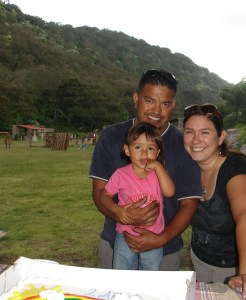
The author and her family | Photo by F.R. Salgado

One friend had to leave her husband in Mexico while she returned to the states with their daughter. I thank her for alerting me to the need for a dual citizen to have both country’s passports to leave the country without problems. Another friend will leave the U.S. with her two sons to go be with her fiancee in El Salvador. Yet another will relocate with her daughter and infant son to be with their father, her husband, in rural Brazil soon. Their travels will be much more heartwrenching than mine. It is because of them and many more like us that I’ll happily incur the personal sacrifices to go to our nation’s capital to make good on the vision to make our stories known to the American government and public.

It’s why on Wednesday morning I will kiss my daughter and husband goodbye, leaving them with about $50 in our Mexican bank account, putting our fate into other hands now. The optimistic side of me, the one who knows how far we’ve come, agreed wholeheartedly with my Mexican brother-in-law last night when we were talking about what we were going to do this week, vetting every last misgiving down to the fear that our book could someday be used for some ill will. He said, “every good deed can be used for bad or for good, but you will never regret doing what you’ve done.” I couldn’t have said it better myself.

Countdown to D.C.

Seven days until we go to Washington to deliver Amor and Exile to Congress. Even though we’ve already bought plane tickets and are thick into planning trip logistics, part of me still “no le ha caido el veinte.” That’s what they say here when something still hasn’t hit you yet.

Maybe it’s because I’m still so far away, in Mexico. I haven’t been to Washington in decades, but its policies affect me daily.

Maybe it’s because I’m still incredulous—and not only that we surpassed our campaign goal to raise $11,000 to send a copy of our book to every member of Congress. It’s still sinking in that we are finally done with our book, something that took over 3 years to complete and that’s required some serious trials of endurance to accomplish as a team.

There are times when this whole ride still seems somewhat dream-like (sometimes nightmarish). I got on this roller coaster nearly 12 years ago, when I met my husband, who is Mexican, in San Francisco in 2001. That’s when everything began to change for me. I discovered that our country has an undocumented class. I discovered that in many cases, marriage makes no difference any more. I had to decide whether to leave my country to keep my marriage together. I had to say goodbye to my friends, my family, my career as a science teacher. I moved to Mexico.

I’m currently sitting in the office of the Secretary of Exterior Relations. I took the bus here in the scorching, pre-rainy season Querétaro heat to get a Mexican passport. I need it in addition to my U.S. passport because I’ve been naturalized here since 2011. Becoming a Mexican citizen isn’t something I set out in life to do, but it was something that made economic and practical sense since my husband and I have to be here at least 10 years until he is eligible to apply for an I-212 waiver of his permanent bar from legally immigrating to the U.S. I am getting a Mexican passport so I can legally leave this country to go to my home country’s capital next week to ask that my husband, my family and millions of others like us might someday have a chance at getting a passport too.

They are very kind to me here, but of course, they are just as much about the rules as they are in the U.S. When I had to pay an unexpected $90 for a passport that I would really prefer to not purchase given my bank account’s precipitously low level, I tried to remember why I am doing this. It’s all for the long run—for my family’s well-being, to travel in good international stead, so I can claim my rightful spot among the many voices asking for legislative redress of a decades-long difficult situation—in person—no longer from afar.

n and m sf march 2006
Nicole Salgado and her husband in San Francisco in 2006

When I was 23 and fell in love with my husband, I soon found out how much we were up against, and my world turned upside down. A long-time activist, I became silenced by fear, by disempowerment, for many more years than I could have imagined. I came close to losing faith in the system. But little by little, once in Mexico, as my cynicism about returning someday converted to self-reliance and survival (and sometimes thriving) in a developing country, I very slowly began to find my voice again. And then came Amor and Exile, after several years in it. I’ve regained some guarded hope in 2013—not just because of my own strength, but also with the support of others. I didn’t know it when I was 23, but I know now that I was never alone—that millions would experience my fate. Their stories, their struggles, are part of what propels me forward.

Perhaps what’s become clearer than ever as a result of this labor of bringing light to the very dark debate over immigration is the following: for every negative commentary or political prediction I hear about this issue, I observe something really positive. Not only is every single one of us who’s separated from our spouses, in exile, or living undocumented in the U.S. not alone—there are millions—but we all have families and friends who want us back safe in our communities. And they have friends too. We have friends and family who are willing to close the distance on thousands of miles and the seemingly similar distances in political rhetoric between where we are and where we want to be. That is the difference between what I knew at 23 and what I know now, and that is what I will try to remember every moment that I’m making it known while in Washington, D.C. next week.

Waiting and demonstrating

We’re rewriting part of Amor and Exile‘s conclusion and epilogue this week to reflect the rapid movement on immigration reform so far this year. “Finishing” is tough, especially since things are developing so fast.

Our book is one of multiple narratives—many stories. Nathaniel and I have kept that structure intentionally, and we happen to like it that way. We could have each chosen to write separate stories, follow a single narrative of a life torn apart by family separation or exile, but that would not entirely reflect reality. Chimamanda Ngozi Adichie, Nigerian author of “Half of a Yellow Sun,” writes: “The single story creates stereotypes, and the problem with stereotypes is not that they are untrue, but that they are incomplete. They make one story become the only story.” And so we continue with our crazy vision of telling many stories at once.

That isn’t to say that we don’t have common threads throughout the stories in our book. Quite the contrary—there are several themes that tie the stories together.  One is the idea of waiting. It’s what all the people whose stories are told in Amor and Exile‘s tale have had to do, for years. It’s what thousands of Americans in exile or separated from their families by immigration law are doing. It’s what I’m doing at this very minute. The waiting could be described as nested at different levels, some common to others in my situation, other bits of waiting my own. Waiting for my opportunity to go to Congress and tell them why my family needs to be included in immigration reform. Waiting for word from a publisher. Waiting to get our message to enough people that it will actually make a significant difference.

Luckily, life in Mexico itself is one of carving deep reserves of personal patience—due to the uniquely different pace of life and bureacracy here as compared to U.S. culture. It prepares me well for the exhausting patience required of having half a life on hold, the American half of my life. It’s also allowed me to practice patience while getting a leg up on making the desired results happen.

Action for Family Unity brochure
Click to download copy of our flier.

Now, the personal and political have to a large degree become indistinguishable, and the waiting is infused with action. One group I’ve become active with, Action for Family Unity, is hoping that the reform plans being unveiled in the House and Senate will include families like ours. Thanks to the lobbying efforts of groups that represent interests like ours in Washington, like American Families United, some plans come close, but so far, we have no guarantees. Demonstrations are coming up next week. I won’t be able to attend—many of us exiled in a foreign country will be unable—but I made a flier for Act4Fams members in attendance to copy and hand out.

We need coverage of the upcoming demonstrations that will call attention to the plight of those of us—American citizen families—who have for too long slipped through the cracks of immigration legislation. We need to shift public opinion and influence reform plans. Those of us who can will hit the streets this weekend and next week to make sure our stories are known, to help advance our group’s interests. If you support our mission and want to attend a rally and take a copy of our flier, join us on Facebook and visit actionforfamilyunity.org.

Meanwhile, I’ll keep demonstrating my resolve, and continuing to carve my patience, from thousands of miles away. I’ll wait for the day that all this becomes unnecessary.

Familes in Exile due to Immigration Laws Unite: American Families United

birthday in Mexico
Nicole, her husband Margarito, and their daughter at her 2nd birthday party in Mexico.

For the last few months, I have been involved in the surge of political activity surrounding the ongoing debate about immigration law. I’ve been very grateful for the support of my fellow American women in exile or separated from their spouses in our Action for Family Unity working group. In further virtual “travels” through the online political organizing world, members of a particularly active group, American Families United (AFU), reached out and let us know about their wonderful work to lobby Congress to include families like ours in legislative reform. To that end, I quickly learned that AFU is working hard to pass waiver reform legislation. AFU is a volunteer-run organization with a paid lobbyist, so it depends on an active membership and annual fees in order to keep its work going forward. I’ve joined, and I urge others in our situation and our extended family members and friends who want to see us back home to also join.

wedding
Nicole and her daughter at her brother’s wedding, Margarito was unable to attend.

For those who are new to my story, this is it: I’m from Central New York, but since 2006, I’ve lived in exile in Central Mexico. My husband and I met 13 years ago near San Francisco. He was a builder, and I had recently graduated from Cornell. I knew he had an immigration record, but I was certain marriage would solve any problems he might have. In fact, my husband’s only chance for legal status was to leave the U.S. and wait 10 years to apply for reentry. Two years after we married, we moved to his hometown of Querétaro, México and can apply for a waiver in 2016. Culture shock, the economy, stress-related and local illnesses have turned my life upside down. But I also built a home, began to teach, had a baby and became a dual citizen. I coauthored the book Amor and Exile with Nathaniel Hoffman from 2011 to present. The book documents the issues faced by Americans married to undocumented immigrants. Despite all the hardships I’ve faced, I haven’t lost hope that someday we’ll obtain my husband’s legal right to join my daughter and I in the U.S., and for thousands of other families like ours to reunite in their homeland.

I think that groups like AFU are our best hope right now to get the chance to come home through this latest round of legislative debate. I can’t think of any more effective voice that is doing this type of work, specifically for our family situations. If anyone is aware of any other organizations doing this type of work, we’d love to know about them, in order to build our alliances and gain as much broad support as possible.

Welcome: Action for Family Unity

Action for Family Unity collage of photos of families separated or in exile due to immigration law

Our stories just keep coming out, and out, and out. The farther we come out, the more scary it feels, but it also feels so wonderful to read and hear the words of our supporters as they join the call to legislators to help bring us home.

These past two weeks have been really amazing. Just last month, I was thinking it would be hard to get families like ours (in exile or facing exile due to immigration laws) organized into a cohesive political force to be dealt with. But then I put out a call asking if anyone knew of specific organizations dedicated to lobbying for our issues. There aren’t many—our presence on the media map is very sparse, despite our large numbers. There are a wide variety of organizations doing great advocacy work and coming up with exciting solutions, too many to list here. But if you’re interested, Prerna Lal, one of my favorite immigration bloggers, suggested a list of sites to start with here.

One thing happened after another. A fellow exile blogger, Raquel Magaña, got back to me with a few ideas of people to be in touch with. The first was Ellin Jimmerson, director and producer of The Second Cooler, a moving documentary that focuses on how immigration is a human rights and workers’ rights issue (Thank you Ellin).

Next thing I knew, I was messaging like crazy with other women in exile—in the U.S., South America, Mexico, South Korea. This was nothing new for many of them—they’ve been in touch with each other for a while—a long time for some, and attracting press to put our issues on the map. But my efforts on activism have been isolated to advocacy back in 2006 (the SF marches) and getting my memoir out over the last 2 years, with the occasional petition signature, and I hadn’t been a part of any online forum before.

heart5

But I also got the sense that the call for action was burning really bright for some women. We’re supportive of the broad movements, we’re supportive of the more specific ones, like those of the DREAMers. But we’re also afraid of getting left out of upcoming reform (Some might say we’ve got a snowball’s chance in hell, but we’re going to try anyways). So suddenly, we formed a group. It has a name and plans for action and collaboration and everything. It all happened so fast. We submitted our pictures and a beautiful mosaic image of them was made. We shared our stories, some intensely personal and not for public eyes. We began building trust in the best way possible without having met our colleagues before, while making up your own rules. We did a petition.

Raquel summed it up well with this comment:

“You will find that every one of these women has a story to be told… and those stories will be told, with heart, with passion, and with the truth of how their individual rights have been overlooked. These ladies will conquer the truth in this history made in their pens and that should promote a government official to execute some relief NOW. When threatened to be overlooked, there is organization. Family unity…there are too many to ignore.”

I am totally floored by how we’re managing to collectively surf this wave of energy we all have, to DO SOMETHING on behalf of our families and others like ours. I have no idea where all this will lead. This is purely voluntary, we all have day jobs, and no financial base to grow from. But I do know that I am feeling a hell of a lot more inspired than I was a month ago, when I wasn’t sure of what I could do beyond writing my story.

I believe in the power of the critical mass. And I wouldn’t be ashamed if we didn’t “make it” this time. As I’ve said before, I’m in this for the long haul.

Most importantly, we’re coming together. For action. Which brings me back to the petition. I wrote it with the help of others and I think it’s very powerful. It sums up our goals pretty well. All the comments I’ve read by my friends, family members, people I don’t even know, bring tears of joy to my eyes. And we hope it will continue to get signed like crazy. Help our group out with that, would you? And stay posted, as this probably won’t be the last thing you’ll hear about it.

Sign the petition here: https://www.change.org/petitions/president-obama-and-congress-bring-home-american-families-in-exile#

One Tomorrow

People have been asking me if I saw Obama’s inaugural speech. I probably should, just to be “informed.” My not having seen it has less to do with me being a cynic than my not wanting to be let down again. Ever since his victory speech in 2008, I’ve been riding a hot air balloon with a slow leak.

Today, idealistic feet planted fully on the ground, even with rumors of impending immigration reform, I prefer not to entertain illusions of quick fixes to my family’s problem of a 10-year exile in Central Mexico. Even so, I just don’t have the heart to reveal the full extent of my reservations to my 90-year old grandmother. Her grandparents were immigrants from Germany, settling to farm in Central New York, much in the same way my father’s side of the family immigrated from Mexico a couple generations ago.

Last week my grandmother told me she really wanted to read our book. I wish I could snap my fingers and a publisher would pick it up this week. More than giving her the satisfaction of reading her favorite granddaughter’s story, it would help explain the tangled tale of why whatever immigration reform the administration is plotting probably won’t benefit my family and me.

IMG_6058
The author and her grandmother “GG”

Last night, she asked me about the inaugural speech. Did I see it? It was great. I told her no, that I’d rather just hear about the new laws getting passed than getting my hopes dashed again. That I wish he would stand up to corporations trying to milk our country dry of every last taxpayer dollar. I’d much prefer to hear about new initiatives passed investing in solar power than hear that Keystone XL is getting new rein in the Lower 48. But when she told me she wanted to send a letter to our senator, Chuck Schumer, I thought to myself, what could Chuck do at this point? We’re not a Dreamer in a university town with several thousand signatures behind us. We’re an unlikely unit of three: one Mexican man with a junior-high education who just wants to have meaningful work, one Ivy-League educated thirty-something, years away from her career and a toddler who might never go to school in her second country of citizenship. But I kept silent, because who am I to knock a great-grandmother’s undying optimism?

I share my grandmother’s hope, and the hope of millions: I want meaningful immigration laws passed, the kind that would allow my husband, daughter and me to return home to the U.S. together as a family. I’d rather see this happen than hearing for the umpteenth time that immigration reform is in the news, or surmise that Latinos are simply pawns in another political game. Our story is a part of the book Amor and Exile because I wanted to share our voice and illustrate an incredibly complex subject in that way that only a personal tale can. In the event that we cannot get our book to the public before the immigration reform debate happens, I’ll need to find another way to contribute to this debate.

But I’ll admit, I’m struggling to figure out how to do more than what I’ve already done. Championing immigration reform is a bittersweet battle for me. Although millions of youth and families like ours—and the U.S. economy—stand to benefit from immigration reform, because our family is suffering from a draconian time bar, the likelihood that we will benefit is very slim.

Of course I do allow opportunities for inspiration. I listened to part of that speech today, to Richard Blanco’s inaugural poem. His message of unity, of vision beyond the things that separate us struck a chord of kinship in me, even released some tears to cleanse my eyes that are frankly too young to be so chronically pessimistic. With this choice of poet, with this message of hope, I look forward to some choice actions taking the place of choice words on Capitol Hill this year. And in listening to this poet’s work, I am inspired to rise to the challenge of communicating exactly why it is that I can’t go home, and how, in an ideal world, my fellow citizens could help get me back there. I’ve always been a willing soldier of idealism, and I know there is a lot of work to do.

Maybe if I get to go back home to the U.S. with my family as a result of this next presidential term, I will watch that inaugural speech after all.

Farewell, Nisha

I wish it was still her saying goodbye to me and not the other way around.

The first time I told our story in mixed company—which is still a rare occasion—was in early 2006, to a group of high school students. My group co-leader and I were both teachers at the Catholic, all-girls Notre Dame High School, in Belmont, and we were on an Intersession volunteer service trip to Tijuana, Baja California, Mexico organized by the non-profit Los Niños.

Nicole Salgado, front row, far right (with student group at Chicano Park, San Diego)

Our trip, together with nearly 20 adolescents and two co-leaders, was incredibly challenging, eye-opening, and life-changing. We all pushed our limits in every sense—physically, emotionally, culturally and even politically. For almost a week, we mixed and poured concrete by hand, we spent an evening with the children of the Casa Hogar Santa Teresita and we learned from many valiant Mexicans working in the social justice in Tijuana.

We encountered the U.S./Mexico border in conversation and in person, from both sides. From the Mexico side, we met migrants headed for a border crossing at a day laborer center. We visited “La Llaga” (the wound) in the flesh: a section of border covered with crosses marking the names and numbers of individuals who’ve died trying to cross. Our students immediately became indignant upon contemplating how a border fence could cause so many deaths—or worse, why so many people would be willing to risk their lives to enter into the U.S. They climbed up on the corrugated metal fence and demanded answers from the border patrolmen cruising by in his jeep. By the end of their 5-10 minute “conversation,” he’d given up debating with them and claimed it was just a job.

Unbeknownst to many, at the time I was struggling with a personal decision I’d made. Later that year I would be accompanying my husband Margarito back to his hometown in Mexico, in what amounted to a self-deportation because Margo was still undocumented, even though we’d been married since 2004.  Thus, it would be my last semester at the high school. Even though I’d always been very candid with my students, our situation wasn’t exactly the kind that lent itself to a simple explanation. I’d also had a lot of uncomfortable experiences when overhearing anti-immigrant sentiment over the years, which had led me to be rather closed about my situation.

But the students’ irrepressible joy and open-mindedness was infectious. While observing the girls in the midst of transformation, becoming so passionate about the fates of people they’d never even met, I couldn’t help but feel inspired. One night back at our “house,” after we’d shared reflections on our experiences during the trip, I took a chance and decided to share my personal story with them. I was nervous and tearful but they couldn’t have been more receptive and understanding. I felt like a weight had been lifted. When our trip came to an end, we shared our best wishes with each other. Many students thanked me for sharing my story. Some assured me that going to Mexico would be an opportunity, not a setback. I wanted to believe them.

It was just one week—but all of us grew as a result. For me, some fear was transformed to courage. Back in the States, the zeal of the trip faded as students got back to the grind, punctuated by a petition we circulated expressing our opposition to the proposed Sensenbrenner anti-immigrant bill up in Congress. Many of the students in our group were graduating that year. My husband and I began preparations for our departure later that summer, I started applying for my Mexican visa.

At the end of the semester, a small handful of students threw me a small going away party. They could have been doing the kind of things most teenagers do on a Friday afternoon, but these young ladies remembered my story, where Margo and I were headed that summer, and they wanted to wish me well. That’s the kind of people they are. The sign said simply “Goodbye and Good Luck.” A snapshot of me, my coworker who’d been on the trip, and 5 students was taken at the event.

Nicole Salgado, back row center. Nisha Tandel, front row, left.

I haven’t looked at that picture in years, but I took it out less than a week ago to remember one specific student in the picture. Her name was Nisha Tandel. I have several pictures of her from that semester. In every single one she is smiling broadly or laughing. I can still hear her laughing as she repeated “está chido” and “está padre” over and over (the two favorite Spanish phrases learned in Tijuana). In another picture of us at graduation, she is wearing a chain of orchids. That was over six years ago.

When I heard last weekend that we had lost Nisha and her sister to a car accident involving her entire family, first, my head spun in disbelief. Then, all these memories came flooding back. Not having known Nisha very well myself, our lives only having touched each others’ for a matter of months, my mourning was intense but not as life-altering as I’m sure it has been and will continue to be for those who were closest to her. But when I think about how she had been headed for a cross-border adventure of her own, to be married in India in January, I can’t help but be impacted by the depth of the entire family’s, the entire community’s loss. And when I remember the time that she came to wish me well, despite how much of my comfort zone and camaraderie I was about to let go of, she faced me with that cheery optimism so firmly the domain of an adolescent girl on the brink of womanhood and hugged me tight. She may not have known how much her gesture meant at the time, the extra vote of confidence it gave me. I can’t make sense of the inexplicable tragedy that claimed her. And to dwell indefinitely in the sadness that her departure creates would go against her Hindu tradition. So I can only think to return her the favor now. Fare thee well Nisha in your journey to the other side. You won’t be forgotten, and your beautiful spirit lives on. Buen viaje, amiga.

6 down and 4 to go

Six years ago, ten years felt like an eternity. Our waiting period. Ten years, and then a request for a “pardon” and a shot at a visa application for my husband. Every year I returned to the States, alone, every time, feeling so sad about having to leave my husband in Mexico. Our hopes are about so much more than a visa. Our hopes are about keeping our family together. For me, having to travel alone for 6 years meant it started to affect me a little less every year than the first time.

Now, on this seventh trip back (one year I went twice), my husband’s the one with tears in his eyes.  For the record, I’ve seen Margo with tears in his eyes maybe three times in the eleven years I’ve known him. This time, it was at dinner. Tomorrow, he bids me and his toddler goodbye for three weeks while she accompanies me as a bridesmaid in my friend’s wedding in CA, and my grandmother’s 90th birthday in NY. It’s perhaps not as traumatic a separation as some families experiences when a parent is deported or jailed, but it hurts all the same. I tried to reassure him that we’d call twice a day, and we’d be in good hands, and I’d be as patient as possible with our daughter in his absence (he’s the good cop), but that wasn’t what was upsetting him. “I know, but it’s just frustrating,” Margo said “it’s difficult.”

I started to tear up myself in realizing just how rough this was going to feel for my husband this time around. But then he remembered the one beer I bought him earlier and the mini bottle of wine I got myself a couple days ago. “I want to be able to celebrate the night before we go,” I had said. “Se me estaba pasando,” Margo said, almost forgetting. We poured a glass and I reminded him of the possibility that when 2016 comes we might actually get lucky. “The first lawyer was a lying optimist, the second and third lawyers were truth-telling pessimists, so maybe this fourth lawyer is a truth-telling optimist,” I said, regarding some recent encouraging legal advice we’d heard about our case.

He managed a half-smile, and we toasted. “To 6 down, and 4 to go,” I said. Que sera asi.