To promote meaningful debate and public awareness about immigration, deportation and exile, we will be giving away copies of the Amor and Exile Kindle book on Thursday and Friday of this week!
What: Download the free ebook for yourself or gift to a friend by clicking the “Give as a Gift” button on the Amazon page!
NOTE: We’d like to move thousands of copies of the book next week and need your help! Please plan to download a digital copy of Amor and Exile from the Kindle store next Thursday and Friday, even if you already have a copy of the book! You can use it as a backup copy, gift to a friend or use it to beef up your digital library. If you support immigration reform or human rights, please share this special opportunity with everyone in your circles! And thanks for all of your great reviews of the book as well!
If you have any questions about the giveaway or how to gift a book to a friend, please email one of us. Thanks again for your support!
***** UPDATE *****
Our giveaway resulted in over 1400 downloads of Amor and Exile in 2 days. We got into the top 500 Kindle books overall, and were #1 for political science and emigration/immigration books on Kindle for a day. Thanks to everyone who participated!
Seven years ago, two women’s lives were changing forever. They both had just made commitments with men who were a persona non gratas, undocumented and unwelcome in the United States, the women’s own nation. One of the women stayed in her home country in the hopes of finding a path to stability, to live without fear. The other left and moved south, into “exile,” with the same hopes as the first. They did not know each other at the time, nor that the life paths on which they’d embarked would eventually cross.
Seven years later, they know each other. Paths have now crossed. The first woman finally moved south, just as the second one was considering when she’d ever possibly return North. Seven years have passed and not much has changed, except for the birth and growth of their daughters, and some deaths — not the least of them the passing of many hopes from those early days.
Nicole and Krystal
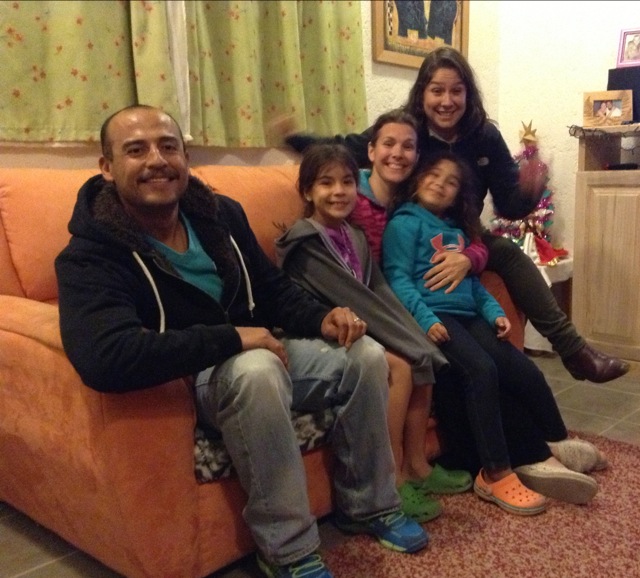
This past week, we welcomed Krystal and her family into our home. Krystal is a longtime blogger (currently posting at LoveMyHusbandMoreThanTheUSA, previously at A Year in the Life of Krystal) now newly fellow “exile wife,” to use the term she coined the night of our first meeting in person. It was a quick stop for them on the way to their own new home in the Central Mexican Highlands, not too far for where we live.
Our meeting was surreal in many ways — first because Krystal is someone I have only “known” virtually for just over a couple years, since around the time when we began writing Amor and Exile. Secondly, Krystal’s arrival to exile is something that I’ve been “watching” her prepare for for some time now — via her public postings of her family’s struggles. As a U.S. Iraqi war veteran and mother dedicated to justice for her family, she long resisted and tried very hard to make it work for them to stay together in the United States. And so it felt somewhat monumental that one of the warriors, a legendary character from our loosely organized but broadly cast net of immigration-affected families was finally “surrendering,” and making the move into exile.
A few days ago I hadn’t actually expected to meet her. I was aware of her family’s impending move south, the vague details of the approach, and where she’d be arriving. But I know how these trips go, having done one myself. When you have your whole life riding on four wheels plus the emotional momentum of a spouse only a few hours’ drive from reuniting with a family he hasn’t seen for years, your forward motion is unstoppable. Side trips beyond a brief foray at the beach seem frivolous, unreasonable even, given the main purpose of your viaje. I also assumed she’d be taking a more southerly route given her destination. So I expected to continue to wish Krystal well virtually, and mourn the inability of yet another one of us to obtain the rights to stay back home with our entire family intact.
But as fast as data flies in the interworld, another member of the network tagged me in a comment that Krystal would be driving through Querétaro. Suddenly, my virtual propriety dissolved and social pressure tactics emerged. I commented that I’d be hurt not to see her — half joking, but also aware of the unique opportunity her drive through our town posed. After a flurry of Facebook messages throughout the day and finding the geographic coordinates of my house so she could locate us (we have no physical address), I discovered I would have house guests that evening after all. I quickly set about making sure that Krystal’s family’s stay would be a moment of comfort in what can be a emotionally grueling journey, having left behind everything they knew and held dear.
The truth was, I needed Krystal’s visit probably as much as she needed a safe place to stay. Despite my abundant blessings, I’d become somewhat depressed recently about the lack of progress in many things I deem important in my life — all related in some way to my state of exile. Combined with a cold winter and my family being sick during the holidays, my mood was worse than blase prior to my friend’s arrival. I was trying hard to pull myself out of my funk, but it wasn’t quite working.
Part of me doubted they’d actually arrive. I surmised they might either get held up in traffic a state away, or decide to push through and make it to their destination by that evening. Later Krystal confessed that her own husband had his doubts, compounded by the fact that I couldn’t give them a house address. We laughed about it once they’d arrived safely, but my husband probably would also have questioned his wife’s wisdom for taking a winding rural route on the outskirts of an unknown city in the dark night, trying to find the town of a friend she’d met on the Internet and who she was Facebook messaging with to find.
But every message I received showed a location a few kilometers closer to my house, and my own husband had offered for their girls to stay in our daughter’s room so they could be comfortable (a rare move of generosity on his part, as he is often more reserved than I), an offer which I extended through the cyberwaves to her. I added that our property was gated and safe and that their dogs were welcome, after intuiting the stress that builds at the end of a ten-hour drive across a foreign country.
Suddenly “they were here,” i.e. in my town, but I was still at work, and the cell phone connections weren’t working. She had thought she was lost but I told her she did better than most local friends at finding the place. I got home as fast as possible and found them at the local convenience store and they followed me home. Luckily, they’d found a taco stand across the street to grab a bite while they waited.
Nicole with Krystal and her family upon their arrival.
Meeting someone you’ve only known virtually, I’m starting to realize, is a really amazing experience. I remember when it first happened for me last summer when we went to D.C. to deliver our book and I met another Crystal, from PA, who’s also part of our network. So many dimensions emerge that are impossible to ascertain via Internet — and a knowledge of someone, and their heart, becomes whole. My first impression was to be deeply impressed that she found my place in the middle of nowhere in the dark, with only a pair of GPS coordinates to go on. Next, I saw a couple that was tired, but still propelled by the weight of their journey. I then saw the two young girls who were along for the ride, and loved and cared for very much. And then the four of them walked up our driveway, across our doorstep and into our home.[/caption]
At one point, Krystal and I were sitting at the dining room table chatting a mile a minute. She had mentioned that her younger daughter understood Spanish but refused to speak it, and I responded that it’d happen naturally, eventually. As her elder daughter, who had thought I was named “Michelle” at first, sat with us sipping Lipton cup-a-soup, she asked her mom a telling question. We’d been spilling terms like “retired” and “exile,” and the eleven year old wanted to know what the e-word meant. I smiled, and let Krystal take that one. “It’s when someone has to leave their home against their will,” she explained. End of the discussion. It hit me then that the girls were aware of the journey but not fully aware of the implications of what was happening — but how could they be? Even though they were every bit a part of the collateral damage of a policy that’s in effect declared war on immigrants, these two precious, displaced souls were happy just being my daughter’s playmates for a night. And that was just fine, because in my opinion, the less you understand of the reasons behind this nonsensical forcible exodus, the better. Afterward, the girls were playing board games, reading picture books, and running joyfully about the house until bedtime could be extended no longer.
After catching each other up on the various latest details of legal laments, family feuds and professional pinings, the parts that don’t get shared in Facebook statuses, we soaked in a moment to just be. Two sovereign women who, despite a lot of fear for having to leave behind something so integral to our identity — our home country — and despite having to become a part of a machisto culture that often fails to nourish our souls about us as much as our own cultures under-appreciated our partners, were still in this for the long haul, come hell or high water.
Her approach to exile will be different than mine — less bound to one location, and will take a proactive stance to try and make the most of it by traveling. It’s an admirable approach, and I truly hope it brings even more satisfaction than we have found in our situation — we are truly lucky to have the house and land we do, but we are essentially bound to it until we have the means again to loosen the legal/economic ties that bind us to this location.
Aside from the simply lovely aspects of having our families meet and hang out, I was struck by the nature of our reunion. How we ran to take the Facebook picture and what an achievement it felt like. How we recounted the meetings among “our kind.” When I met Crystal, when Krystal met Jennifer, when Raquel met Giselle, and so on. It’s as if every meeting is special — and it is — as we know, without articulating it, that we’re a burgeoning demographic, a movement without a leader, a spontaneous organization, allied without really wanting it — who asks for a sisterhood that is defined by a loss of autonomy? — but also absolutely needing it, growing bonds where they’ve been forcibly severed, by our own country.
This kind of alliance is the kind that reminds me of spontaneous healing, where the body patches up a scratch or a cut, where positivity takes over pain without thought or intention. I saw this in my daughter’s total welcoming of strangers in her happy Spanglish and when I heard the younger one finally responding in her own adopted tongue as naturally as I assumed she would. I saw this in my daughter’s stuffed animals I found among the bedding where the girls stayed, the ones she’d lent them so they could feel a little more “home” along their journey.
It was a positive force that brought our families together in the first place, the urge and instinct to unite with love rather than ostracize with hate. It’s what I wish more for our daughters’ world when we are no longer. This kind of encounter helped renew my faith that I’ve done the right things in a time when the results are sometimes so hard to live with, it’s so easy to question my own wisdom, question what the hell kind of world we are exactly living in, anyways.
Krystal and her family on their way to their new home in exile
So thanks for stopping by, Krystal. Blessed be your journey.
2013 was a big year for Amor and Exile: True Stories of Love Across America’s Borders, to say the least! We finished the manuscript, published under our own imprint and launched in the United States and Mexico. Thanks to the outpouring of support from friends, family and supporters of immigration reform and independent journalism, Amor and Exile is now available anywhere you buy books!
From our “Send Amor and Exile to Congress” campaign to sales in the U.S. and Mexico, Amor and Exile sold over 1,000 copies in 2013 — both print and Kindle. We also held 14 public readings on both sides of the border. We are happy to be contributing in a positive way to the immigration reform debate!
To see the year-in-review (with photos!) of other major milestones for A&E and immigration issues, click here. We would not have been able to to pull off such a successful year without YOUR support, so we’d like to take this moment to THANK you and wish you a Happy Holidays.
Big things are in store for A&E in 2014, also thanks to our growing network and media presence. We’re inviting our entire network of supporters to join us in increasing our reach with the American and international public and furthering meaningful debate on immigration. In that spirit, you can help us reach our goals by doing any of the following:
Review Amor and Exile, on Amazon. Positive reviews help increase our ranking and visibility on Amazon.com. Get more tips on how to do a review for us here.
Spread the word. Tell your friends about A&E. Share your copy or buy one for a friend. If you have a favorite bookstore that you think might like to carry our book, send us their contact information or go in and order the book — we have Expanded Distribution that allows any bookstore to carry us. See where A&E is currently being sold here. If you know of local book clubs or schools interested in our topic, let them know about us — book clubs and schools receive a 10% discount.
Help us make an impact during the 2014 Congressional debates. get in the know on immigration issues, by checking out our 2013 Year-In-Review. Stay tuned in for more ways to help here on our website. Commenting on blog posts, sharing issues on social media and contacting your representatives when bills are up for votes will go a long way toward enacting more humane immigration policies that affect families like Nicole and Margo’s, Suzie and Roberto’s, J.W. and Gabriel’s, and Veronica and Juan’s.
Thanks again, happy holidays and we look forward to hearing from you in 2014.
2013 was a big year for Amor and Exile and for the pro-immigration movement. Brush up on the issues of the past year with this Amor and Exile Year-In-Review for 2013.
January
Obama administration announces stateside waiver processing, creates relief for some families (Take Two, Southern California Public Radio)
February
Senate “Gang of Eight” reveals comprehensive immigration reform plan
Advocates for family-based immigration relief found group Action for Family Unity, create petition calling for end to time bans (Change.org)
“Send Amor and Exile to Washington” campaign raises over $12,000 and delivers a copy to every member of Congress, the nine Supreme Court justices, President and First Lady Obama and Vice-President Biden and other D.C. officials
Nathaniel’s work as Idaho journalist and A&E highlighted (Idaho Press-Tribune)
Clockwise from bottom L: Constituent letters to Congressional reps; Nicole and Nate meet with Rep. Luis Gutierrez; Nicole and Nate after hand-delivering over 100 copies of A&E; Nicole on Capitol Hill; Nicole at Ukazoo reading in Baltimore; Nicole, cover designer Gilad Foss and Nate in Baltimore; Nate and Margi Hoffman mailing books to D.C. officials; and the audience at the A&E launch at Hyde Park Books in Boise, ID.
July
Nicole launches A&E in Mexico with Nathaniel skyping in, starting in Querétaro at the Casa del Atrio (amorandexile.com)
A&E and Nicole’s story covered in Boulder, Colorado (Boulder Weekly)
Nathaniel hosts reading at the American Friends Service Committee in Denver with a call-in by Nicole
Top: Nicole at La Casa del Atrio reading, Querétaro, México. Bottom: Nicole and friends of A&E at the Querétaro reading
August
Reading in San Miguel de Allende, home of J.W. Lown, profiled in A&E
Edgar Falcon marries on the border in highly publicized wedding on the El Paso/Mexico border (Texas Tribune)
Clockwise from top: San Miguel de Allende reading, Nicole with supporter at SMA reading, U.S. citizen Edgar Falcon marries Mexican citizen Maricruz Valtierra at U.S./Mexico border in August.
Rift surfacing between some immigration reform activist groups (prernalal.com)
House Reps Pearce (R-NM) and O’Rourke (D-TX) sponsor the American Families United Act (AFU website)
Nathaniel signs copies of Amor and Exile at reading at the International Institute of the Bay Area in October.
November
Nicole and Margo’s story featured alongside series of profiles of SF Bay Area immigration activists (SF Bay Guardian)
Town-hall discussion of A&E and immigration issues at Rediscovered Books in Boise and Baltimore event co-hosted by Chizuk Amuno and Beth-El congregations (amorandexile.com)
Clockwise from upper L: Nate on the air with Nicole on the Midday with Dan Rodricks show; Nicole skyping in from Mexico with Deyanira and Ben at Rediscovered Books reading; the audience at the RD Books reading in Boise; the audience at the reading at the Jefferson Clinton Hotel in Syracuse, NY; Nicole and her grandmother, Thelma Kinney, at the Syracuse reading, the day before Thanksgiving.
Deyanira, Ben and Nicole at Amor and Exile reading at Rediscovered Books in Boise.
Amor and Exile: True Stories of Love Across America’s Borders has been featured at several public events and earned media spots across the U.S. in the last month.
In September, Amor and Exile received a positive review from immigration lawyer Teresa Statler in AILA Voice, a quarterly publication of the American Immigration Lawyers Association (September/October 2013 issue, Reader’s Corner, pg. 17). In her review, “Love in the Time of Deportation and Many More Heart-Wrenching Stories,” Statlerhad this to say about Amor and Exile: ‘Salgado movingly speaks of her own and of other Americans’ ‘disenfranchisement’ and exile abroad due to the Illegal Immigration Reform and Immigrant Responsibility Act… Hoffman’s legal information is very accurate, thanks to several AILA members with whom he consulted while writing this book… Let us hope that in this time of potential immigration reform, members of the House especially read these gripping personal stories of immigration and feel moved to make changes in the law that are long overdue.’
In events, on October 24th, Nathaniel joined the International Institute of the Bay Area in San Francisco, CA for a wine and cheese reading and discussion. Nicole skyped in long distance from Piedra Grande, Edo. Mexico, where she was leading a volunteer training for Peace Corps Mexico. Both authors dialogued with the audience about the challenges of life in exile and the hopes for immigration reform.
Prior to the event, on Tuesday, October 22, Amor and Exile went global on PRI The World, a program of the BBC, when Jason Margolis, a reporter with PRI released his story featuring Nathaniel and Nicole’s work in: “American citizens, in love and in exile, are waiting for immigration reform,” a 5-minute radio spot with accompanying transcript. Immediately following the SF event, Nathaniel was also interviewed on KQED, a local San Francisco NPR station, about his work with Amor and Exile.
The first week in November, Amor and Exile was featured at the Krieger Schechter Day School Book Fair in Baltimore, Maryland (map). Later that week, on November 7th, Nathaniel and the staff of Rediscovered Books in Boise, Idaho hosted a town hall style discussion of immigration reform featuring the stories of Amor and Exile and others like them (map). Nicole joined the discussion via Skype from Mexico. Also in attendance were Ben and Deyanira, one of the couples from the book, who recently returned to Idaho from a 3-year exile in Mexico; Leo Morales, communication director of the ACLU of Idaho; and Ashlee Ramirez, a representative of American Families United (AFU), an organization that supports HR 3431, the American Families United Act. Ramirez was in Idaho meeting with Idaho Rep. Raúl Labrador, a Republican who is seen as key to any progress on immigration reform in the House.
A few weeks later, Rebecca Bowe, a reporter with San Francisco Bay Guardian, profiled Nicole for an article she was writing about SF Bay Area immigration activists. Nicole’s story was included in the series of profiles of undocumented activists because although she herself is an American citizen, she is a former SF Bay Area resident now in exile due to immigration law, now “agitating from exile.” The article, “Undocumented and unafraid,” came out on Tuesday, November 12, 2013, and Nicole and Amor and Exile are highlighted onpgs. 1, 6, and 7.
This Thursday, November 21st, Nathaniel and Nicole will participate in the radio show Midday with Dan Rodricks(WYPR), a Maryland-wide, live public-affairs talk show, to discuss the book, and promote the Chizuk Amuno reading on November 24th. The show will air from 12 to 1 pm EST, with callers and email questions and will be streamed live at the link above.
Be sure to check out, share and/or comment on one of the above articles and learn more about recent activity in Congress regarding family reunification oriented immigration reform. And view our Events page to catch one of our upcoming events.
But on the subject of responsibility, it raises a good point as to whose role it is to deal with the issue of immigration reform. King asserts that the full responsibility for their illegal status lies with the immigrant him or herself, because they step into the situation willingly. One could assume that the next logical assumption is that undocumented immigrants want to alleviate themselves of that responsibility, i.e. through amnesty. However, I’d be hard pressed to think of an undocumented immigrant that I know who is asking someone else to take responsibility for them. Far from it, actually, especially given how hard workers most of the undocumented immigrants I have ever known are. They are usually the ones who are taking responsibility for many others—their American citizen children, their American citizen spouses, their family and extended family members back home. Without even wanting to, millions of undocumented immigrants shoulder economic responsibility for American citizens. They pay taxes into the IRS coffers and into a Social Security system that they will never see a dime from—to the tune of $11.2 billion dollars in 2010—which, when compared to giant American corporations who pay little to nothing, makes you wonder, why the misdirected vilification?
Beyond those who have citizen or permanent resident spouses or children, it’d be difficult to name an undocumented immigrant who hasn’t contributed in some responsible way to American society by contributing to the economy, producing crops, building homes, caring for young children, preparing food, working in virtually all aspects of American industry, in some way adding their daily bread to the fabric of American society, whether seen or unseen. Denying their contributions does not make them or their contributions disappear.
The undocumented immigrant whose level of responsibility I knew best was the one who I lived with in the U.S. until 2006—my husband. We moved to his home country of Mexico in 2006 because, despite being legally married and seeking avenues for legalization for several years, I could not assume the legal responsibility of adjusting his status, although we were legally married. Ironically, in the end, it was my husband the undocumented immigrant, who was the one who took primary financial responsibility for our family, in that he was making better income despite our disparate educational backgrounds, and allowed me to pay off my car loan, as well as my college loan, five years early.
But the panorama never looked better than bleak for obtaining legal status for my husband, despite several trips to lawyers. In 2006, I was working as a science teacher and finishing up my Masters. That same year, House Rep. James Sensenbrenner proposed laws that would have made it a felony for me to even drive in the same vehicle as my husband. One state after another passed laws that treated undocumented immigrants more and more harshly. I doubted the political will of Congress to finally live up to its country’s immigrant legacy and make good on its debt to the millions of individuals who have contributed for decades to American society, regardless of the piece of paper they did not hold.
Almost a decade after we’d married in California, I ended up in Mexico with my husband, we had a daughter, and I’d almost given up hope that I’d ever get back to the United States with him. I’d made my peace that maybe we might never go back because the political climate in Washington is as fickle as the wind that blows. But then that spark of political will stirred this past January, as we were finishing the manuscript of Amor and Exile. Those who’d been hopeless for so long suddenly were taken with optimism once again. We organized, we rallied, we lobbied, our messages were well received.
Many people didn’t want to engage in the rollercoaster ride of hope, fear, optimism, and pessimism. They’d been let down too many times before. They didn’t want to be let down again. But many felt it was different this time, that we were reaching a critical mass of support for immigration reform, and that we really had a chance at progress. Now many of us are questioning again.
It’s partially because there are some politicians who are bound and determined to make sure our hopes are ignored, that our demands go unanswered, that societal justice continues to go unserved. Another part is that we who are living this struggle on a daily basis are tired. We have lives, we can not go on fighting indefinitely. We also wonder when our fellow citizens will care enough to go to bat for us with their elected officials and help drive the support for this effort home—essentially, to bring our families home.
I may have found the way to survive, I’ve got my Plan B’s, and I might still thrive in the long run. But I have counterparts whose lifelines are much thinner. So much work has been put in by thousands of activists, lobbyists and legislators toward immigration reform.
So whereas some legislators may not see 11 million undocumented people’s fate as their responsibility, let me take a stab at a response to King’s assertion. They don’t want to be your responsibility, Rep. King. They want to be officially recognized for the responsibilities they’ve already taken on and met in a way that often exceeds the level of responsibility that many Americans will ever know.
And to go a step further, I’d assert that yes, it is the role of legislators to deal with immigration law—which is, in fact, the reason why undocumented immigrants have the illegal status that they do. The Illegal Immigration Reform and Immigration Responsibility Act (IIRIRA) changed the rules of the game in a drastic way in 1996, criminalizing undocumented immigration to an unprecedented extent that has had far-reaching effects not just on the lives of 11 million undocumented immigrants, but also in the fates of hundreds of thousands of their U.S. citizen family members, and members of their communities. An extent that some might say, changed the face of immigration in a country founded by immigrants.
Thankfully, many legislators still see it as their role to assume responsibility for fixing a broken immigration system that is currently causing more harm than it should. Even Speaker of the House John Boehner, who appeared wholly unsupportive of SB 744 just last month, has conceded the “need to educate members about the hundreds of issues involved in fixing our legal immigration system and the problem of those who are here in an undocumented fashion.”
I have an important reminder for House representatives. Even if you don’t see undocumented immigrants’ fate as your responsibility, surely you would agree it is your responsibility to answer to American citizen constituents. And in the very least, you should read your mail. So I very respectfully ask you to please read the piece of mail that arrived in your Washington offices last month. That was when you received a copy of my book Amor and Exile, which Icoauthored with journalist Nathaniel Hoffman. It describes the stories of more than 12 different Americans like myself who have had their families split up or who’ve had to move abroad because of the fall out from laws like IIRIRA—which, being a set of laws passed by Congress, are indeed the purview of Congress. Kill a few responsibilities with one stone: read Amor and Exile. Constituent letters from supporters who sent Amor and Exile to Washington, D.C.
In the next two weeks, Amor and Exile: True Stories of Love Across America’s Borders will be presented for the first time in Central Mexico, with readings in Querétaro and San Miguel de Allende, hosted by Nicole Salgado. At both events, co-authors Salgado and Nathaniel Hoffman will read excerpts of the book with a short summary in Spanish, and answer questions from the audience. Hoffman will attend virtually, via the Internet. Both events are free and open to the public. Copies of Amor and Exile will be available for sale at the events.
The Querétaro reading will be this Wednesday, July 24th, at 7 pm, at the Casa del Atrio, Allende Sur 15, in Querétaro´s historic downtown. The San Miguel de Allende reading will be Saturday, August 3rd at the San Miguel Public Library in the Sala Quetzal, entry from Relox-50, San Miguel Centro Historico.
In Amor and Exile, Salgado details her inability to legalize her Mexican husband because of a permanent bar that he incurred due to a previous illegal entry, and how they arrived together to Querétaro in 2006 to wait out the 10 years before he can apply for legal entry. In addition to providing the backdrop of U.S. immigration policy history, journalist Hoffman tells the stories of more than 12 couples torn apart or displaced by current immigration law, including the experience of former San Angelo, Texas mayor and current San Miguel resident, J.W. Lown.
Amor and Exile offers a new perspective on a problem that affects hundreds of thousands of Americans and their families. As U.S. legislators debated immigration reform in June, Hoffman and Salgado raised more than $12,000 dollars to publish their book, travel to Washington, D.C., and deliver 550 books, to each of the members of Congress, the President and Vice-President, the Supreme Court, and other officials, along with letters from constituent supporters. Amor and Exile provides important perspective for the current immigration reform debate going on in Congress and demonstrates why millions of people need a more humane immigration policy that reestablishes families’ autonomy.
We hope you will join us! You can obtain more information about the local events by contacting nicole@amorandexile.com
Casa del Atrio, site of upcoming Amor and Exile reading in Querétaro, México
En las siguientes dos semanas, las primeras dos lecturas de Amor and Exile: True Stories of Love Across America’s Borders serán en México Central, por coautora Nicole Salgado. En los dos eventos, los coautores, Salgado y Nathaniel Hoffman, leyerán excerptos del libro y estarán dispuestos para contestar preguntas de la audiencia. Hoffman estará presente por medio de internet. En las dos ocasiones, la entrada es abierta al público y gratuito y libros estarán a la venta.
En Amor and Exile, Salgado detalla la imposibilidad de legalizar su esposo mexicano debido a una barra permanente que él tuvo por una entrada ilegal previa, y como llegaron a Querétaro juntos en 2006 para esperar 10 años antes de que él puede solicitar una entrada legal. Coautor y periodista Hoffman relata la historia de la política migratoria en los Estado Unidos y las experiencias de mas de 12 parejas con situaciones como Nicole, que han sido afectados negativamente de parte de leyes migratorios actuales de Estadosunidos.
Amor and Exile ofrece una nueva perspectiva sobre un problema que afecta cientos de miles de Americanos y sus familias. Mientras legisladores Estadounidenses debatieron reforma migratoria en junio, Hoffman y Salgado recaudaron mas de $12,000 dólares para publicar su libro, viajar a Washington, D.C. y entregar 550 libros, a cada uno de los miembros de Congress, el presidente y vicepresidente, la Suprema Corte y otros oficiales. Amor and Exile provee importante perspectiva para el actual debate en Congress de Estadounidos, y demuestra porque millones de personas necesitan una política migratoria mas justa que restablece la autonomía de las familias.
Esperamos que nos acompañen. Se puede conseguir más información acerca de los eventos locales al escribir nicole@amorandexile.com
Sala Quetzal, San Miguel Public Library, site of August 3rd reading of Amor and Exile
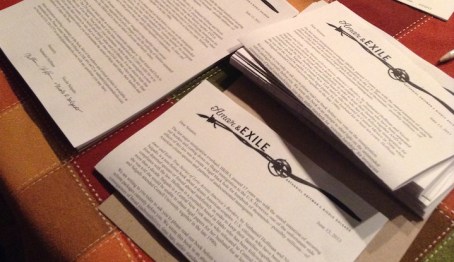
We are honored that Rep. Luis V. Gutierrez (D-Chicago) is recommending Amor and Exile to his colleagues in the House, all of whom received a copy within the last week… copied below is a memo that went out to members of the House this morning:
Subject: Immigration, Judiciary: Dear Colleague: Amor and Exile Tells the Story of Families Separated or Exiled by Immigration Laws
Amor and Exile Tells the Story of Families Separated or Exiled by Immigration Laws
From: The Honorable Luis V. Gutierrez Date: 6/21/2013
This week, a remarkable book was delivered to your office that I hope you will read, share, and learn from. Amor and Exile: True Stories of Love Across America’s Borders, tells the story of U.S. citizens who fall in love with undocumented immigrants only to find themselves trapped in a legal labyrinth, stymied by our nation’s immigration laws.
Journalist Nathaniel Hoffman visited both sides of the border to document the lives of couples split apart by borders or exiled from America. His coauthor, Nicole Salgado, provides her firstperson account of life in the U.S. with her husband while he was undocumented, her decision to leave the country with him, and their seven years of exile together in Mexico.
I had the opportunity to visit with Nathaniel and Nicole in my office earlier this week and have found the stories they write about — and the story Nicole still lives — very powerful in conveying what is at stake in our nation’s immigration debate. They raised the funds from supporters in 28 states to be able to provide copies of their book to every Member of the House and Senate so that we come to know and understand the American citizens whose lives we are talking about when we discuss immigration, deportation, and efforts to reunite families.




 In September, Amor and Exile received a positive review from immigration lawyer Teresa Statler in AILA Voice, a quarterly publication of the American Immigration Lawyers Association (September/October 2013 issue, Reader’s Corner, pg. 17). In her review, “