


In a transcript of an appearance on Univision’s “Al Punto con Jorge Ramos,” House Representative Steve King claimed that, “it isn’t [his] responsibility to solve that problem,” in reference to the 11 million undocumented immigrants in the United States. This is the same Rep. King (R-IA) who has compared undocumented immigrants to dogs and asserted that he’s picked up immigrants with calves the size of cantaloupes, a remark that’s earning him the distancing of fellow House Republicans John Boehner, Eric Cantor and Raul Labrador.
But on the subject of responsibility, it raises a good point as to whose role it is to deal with the issue of immigration reform. King asserts that the full responsibility for their illegal status lies with the immigrant him or herself, because they step into the situation willingly. One could assume that the next logical assumption is that undocumented immigrants want to alleviate themselves of that responsibility, i.e. through amnesty. However, I’d be hard pressed to think of an undocumented immigrant that I know who is asking someone else to take responsibility for them. Far from it, actually, especially given how hard workers most of the undocumented immigrants I have ever known are. They are usually the ones who are taking responsibility for many others—their American citizen children, their American citizen spouses, their family and extended family members back home. Without even wanting to, millions of undocumented immigrants shoulder economic responsibility for American citizens. They pay taxes into the IRS coffers and into a Social Security system that they will never see a dime from—to the tune of $11.2 billion dollars in 2010—which, when compared to giant American corporations who pay little to nothing, makes you wonder, why the misdirected vilification?
Beyond those who have citizen or permanent resident spouses or children, it’d be difficult to name an undocumented immigrant who hasn’t contributed in some responsible way to American society by contributing to the economy, producing crops, building homes, caring for young children, preparing food, working in virtually all aspects of American industry, in some way adding their daily bread to the fabric of American society, whether seen or unseen. Denying their contributions does not make them or their contributions disappear.
The undocumented immigrant whose level of responsibility I knew best was the one who I lived with in the U.S. until 2006—my husband. We moved to his home country of Mexico in 2006 because, despite being legally married and seeking avenues for legalization for several years, I could not assume the legal responsibility of adjusting his status, although we were legally married. Ironically, in the end, it was my husband the undocumented immigrant, who was the one who took primary financial responsibility for our family, in that he was making better income despite our disparate educational backgrounds, and allowed me to pay off my car loan, as well as my college loan, five years early.
But the panorama never looked better than bleak for obtaining legal status for my husband, despite several trips to lawyers. In 2006, I was working as a science teacher and finishing up my Masters. That same year, House Rep. James Sensenbrenner proposed laws that would have made it a felony for me to even drive in the same vehicle as my husband. One state after another passed laws that treated undocumented immigrants more and more harshly. I doubted the political will of Congress to finally live up to its country’s immigrant legacy and make good on its debt to the millions of individuals who have contributed for decades to American society, regardless of the piece of paper they did not hold.
Almost a decade after we’d married in California, I ended up in Mexico with my husband, we had a daughter, and I’d almost given up hope that I’d ever get back to the United States with him. I’d made my peace that maybe we might never go back because the political climate in Washington is as fickle as the wind that blows. But then that spark of political will stirred this past January, as we were finishing the manuscript of Amor and Exile. Those who’d been hopeless for so long suddenly were taken with optimism once again. We organized, we rallied, we lobbied, our messages were well received.
Many people didn’t want to engage in the rollercoaster ride of hope, fear, optimism, and pessimism. They’d been let down too many times before. They didn’t want to be let down again. But many felt it was different this time, that we were reaching a critical mass of support for immigration reform, and that we really had a chance at progress. Now many of us are questioning again.
It’s partially because there are some politicians who are bound and determined to make sure our hopes are ignored, that our demands go unanswered, that societal justice continues to go unserved. Another part is that we who are living this struggle on a daily basis are tired. We have lives, we can not go on fighting indefinitely. We also wonder when our fellow citizens will care enough to go to bat for us with their elected officials and help drive the support for this effort home—essentially, to bring our families home.
I may have found the way to survive, I’ve got my Plan B’s, and I might still thrive in the long run. But I have counterparts whose lifelines are much thinner. So much work has been put in by thousands of activists, lobbyists and legislators toward immigration reform.
So whereas some legislators may not see 11 million undocumented people’s fate as their responsibility, let me take a stab at a response to King’s assertion. They don’t want to be your responsibility, Rep. King. They want to be officially recognized for the responsibilities they’ve already taken on and met in a way that often exceeds the level of responsibility that many Americans will ever know.
And to go a step further, I’d assert that yes, it is the role of legislators to deal with immigration law—which is, in fact, the reason why undocumented immigrants have the illegal status that they do. The Illegal Immigration Reform and Immigration Responsibility Act (IIRIRA) changed the rules of the game in a drastic way in 1996, criminalizing undocumented immigration to an unprecedented extent that has had far-reaching effects not just on the lives of 11 million undocumented immigrants, but also in the fates of hundreds of thousands of their U.S. citizen family members, and members of their communities. An extent that some might say, changed the face of immigration in a country founded by immigrants.
Thankfully, many legislators still see it as their role to assume responsibility for fixing a broken immigration system that is currently causing more harm than it should. Even Speaker of the House John Boehner, who appeared wholly unsupportive of SB 744 just last month, has conceded the “need to educate members about the hundreds of issues involved in fixing our legal immigration system and the problem of those who are here in an undocumented fashion.”
Mexico readings of Amor and Exile | Lecturas de Amor and Exile en México

In the next two weeks, Amor and Exile: True Stories of Love Across America’s Borders will be presented for the first time in Central Mexico, with readings in Querétaro and San Miguel de Allende, hosted by Nicole Salgado. At both events, co-authors Salgado and Nathaniel Hoffman will read excerpts of the book with a short summary in Spanish, and answer questions from the audience. Hoffman will attend virtually, via the Internet. Both events are free and open to the public. Copies of Amor and Exile will be available for sale at the events.
The Querétaro reading will be this Wednesday, July 24th, at 7 pm, at the Casa del Atrio, Allende Sur 15, in Querétaro´s historic downtown. The San Miguel de Allende reading will be Saturday, August 3rd at the San Miguel Public Library in the Sala Quetzal, entry from Relox-50, San Miguel Centro Historico.
In Amor and Exile, Salgado details her inability to legalize her Mexican husband because of a permanent bar that he incurred due to a previous illegal entry, and how they arrived together to Querétaro in 2006 to wait out the 10 years before he can apply for legal entry. In addition to providing the backdrop of U.S. immigration policy history, journalist Hoffman tells the stories of more than 12 couples torn apart or displaced by current immigration law, including the experience of former San Angelo, Texas mayor and current San Miguel resident, J.W. Lown.
Amor and Exile offers a new perspective on a problem that affects hundreds of thousands of Americans and their families. As U.S. legislators debated immigration reform in June, Hoffman and Salgado raised more than $12,000 dollars to publish their book, travel to Washington, D.C., and deliver 550 books, to each of the members of Congress, the President and Vice-President, the Supreme Court, and other officials, along with letters from constituent supporters. Amor and Exile provides important perspective for the current immigration reform debate going on in Congress and demonstrates why millions of people need a more humane immigration policy that reestablishes families’ autonomy.
We hope you will join us! You can obtain more information about the local events by contacting nicole@amorandexile.com

En las siguientes dos semanas, las primeras dos lecturas de Amor and Exile: True Stories of Love Across America’s Borders serán en México Central, por coautora Nicole Salgado. En los dos eventos, los coautores, Salgado y Nathaniel Hoffman, leyerán excerptos del libro y estarán dispuestos para contestar preguntas de la audiencia. Hoffman estará presente por medio de internet. En las dos ocasiones, la entrada es abierta al público y gratuito y libros estarán a la venta.
La lectura en Querétaro será este miercoles, 24 de julio, a las 7 pm, en la Casa del Atrio, Allende Sur 15, en el Centro Histórico de Querétaro. La lectura en San Miguel será en la Sala Quetzal de la Biblioteca Publica de San Miguel de Allende, entrada por Relox 50-A, Centro Histórico.
En Amor and Exile, Salgado detalla la imposibilidad de legalizar su esposo mexicano debido a una barra permanente que él tuvo por una entrada ilegal previa, y como llegaron a Querétaro juntos en 2006 para esperar 10 años antes de que él puede solicitar una entrada legal. Coautor y periodista Hoffman relata la historia de la política migratoria en los Estado Unidos y las experiencias de mas de 12 parejas con situaciones como Nicole, que han sido afectados negativamente de parte de leyes migratorios actuales de Estadosunidos.
Amor and Exile ofrece una nueva perspectiva sobre un problema que afecta cientos de miles de Americanos y sus familias. Mientras legisladores Estadounidenses debatieron reforma migratoria en junio, Hoffman y Salgado recaudaron mas de $12,000 dólares para publicar su libro, viajar a Washington, D.C. y entregar 550 libros, a cada uno de los miembros de Congress, el presidente y vicepresidente, la Suprema Corte y otros oficiales. Amor and Exile provee importante perspectiva para el actual debate en Congress de Estadounidos, y demuestra porque millones de personas necesitan una política migratoria mas justa que restablece la autonomía de las familias.
Esperamos que nos acompañen. Se puede conseguir más información acerca de los eventos locales al escribir nicole@amorandexile.com

Immigration bans will keep some same-sex couples in “amor and exile”

Yesterday’s Supreme Court ruling striking down Section 3 of the “Defense of Marriage Act,” or DOMA, opens up the U.S. immigration system to same-sex couples. Tens of thousands of Americans are now able to sponsor their partners for immigration purposes, entitling them to green cards and eventual citizenship.

Binational couples celebrated the end of DOMA all over the world, as many have been forced into exile, unable to live in the United States legally with their partners. Glenn Greenwald, journalist for The Guardian who recently broke the NSA snooping scandal, lives in Brazil with his partner, David Miranda. They could now benefit from the end of DOMA by applying for a spousal or fiancé visa—they have already demonstrated to the Brazilian government that their relationship is the equivalent of a married couple, and Greenwald earned full immigration benefits there.
From Amor and Exile:
“Greenwald said that they would like to live in the United States at some point, as it would be convenient for his work as a frequent television and radio commentator. But they are also happy in Brazil. He also does not want to be a poster child for same-sex couples in exile, though he writes about it from time to time.
Greenwald, a frequent critic of President Obama’s continued War on Terror policies and other federal issues, says that the Obama administration’s refusal to defend DOMA is one of the best things the administration has done. The courts will overturn the law and immigration judges will be able to grant spousal benefits to same-sex couples, he says.”
Yesterday’s news proved that prediction correct. U.S. Citizenship and Immigration Services Director Alejandro Mayorkas told the American Immigration Lawyers Association conference in San Francisco today that the agency has been keeping track of immigrant visa applications from same-sex couples for the last year and will expedite their review, now that the agency officially has that authority.
But some percentage of the estimated 24,000 same-sex binational couples in the U.S. and the many couples living abroad will now face the same immigration hurdles that other binational couples like Nicole and Margo have faced—bans from the United States because of their immigration history.
Our book anticipated the end of DOMA in this way. Up until yesterday, all same-sex couples faced a different set of immigration barriers—the total lack of access to the immigration system. Today, many will face the same barriers that millions of straight couples have faced since 1996.
Greenwald’s immigration case is relatively straightforward since he met his partner abroad and Miranda has no immigration violations on his record. But J.W. Lown’s partner, whom I call Gabriel in the book, to protect his identity, is subjected to a 10 year ban, as is Jenny Phipps’ wife, Ottie.

Lown is the former mayor of San Angelo, Texas, a Republican, and for the past four years, a real estate agent in San Miguel de Allende in Central Mexico. Gabriel entered the United States illegally and stayed for more than a year, earning a 10 year ban. He contacted the U.S. Embassy in Mexico City recently and they told him he’s not even eligible for a tourist visa.
“He went to the embassy and they said to come back in 2019,” Lown told me this morning, adding that DOMA is a life changer. But it’s not going to be a simple visa application for J.W. and Gabriel—they are going to have to apply for an extreme hardship waiver and prove that it’s been a hardship for them to live abroad. J.W.’s story of fleeing south with Gabriel on the eve of his fourth swearing-in as the popular mayor of San Angelo, will probably help the application process, but they will need to consult a lawyer, go to the U.S. Consulate in Ciudad Juarez twice and take the risk of a denial, a process that is detailed in Amor and Exile.

Jenny and Ottie are even further away, in the Netherlands, and are really unsure of how to proceed. They can’t afford a lawyer and are not even sure why Ottie has a 10-year ban.
“We don’t know how it’s going to affect us yet because Ottie still has that 10 year bar,” Jenny said. “We’ve just been kind of numb from the news. It’s like, what do we do now, what can we do now? Are we locked, imprisoned for the next six years?”
More than 900 people joined a conference call today with Immigration Equality, a group that has been fighting to overturn DOMA and help binational same-sex couples access the immigration system. They had questions about visa waivers, when to apply for immigrant status, how to explain previous tourist or work visas in light of new family-based applications and many other questions. Immigration attorney Prerna Lal posted this list of immigration benefits that the end of DOMA allows, along with a list of continued barriers for gay and lesbian couples.
Also today, the comprehensive immigration reform bill, SB 744, passed the U.S. Senate, and while it does not include any provisions specifically for same-sex couples, gay couples now have an equal stake in the bill, in the wake of DOMA’s demise. That means that eased hardship waiver provisions in the bill could help couples like JW and Gabriel and Jenny and Ottie as well.
The Senate bill now moves over to the House, which has its own, still unclear agenda on immigration reform. One thing is clear however: the marriage equality movement succeeded in a big way yesterday in convincing the nation that relationships forged in love should be treated equally, regardless of gender or immigration status. If that same momentum carries forward for the larger immigration reform effort, American citizens stand to benefit in numerous ways, not the least of which is the power to determine whom they choose to marry and where they choose to live.
Dear Colleague, Re: Amor and Exile, From The Honorable Luis V. Gutierrez

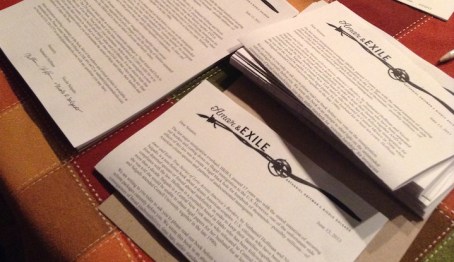
We are honored that Rep. Luis V. Gutierrez (D-Chicago) is recommending Amor and Exile to his colleagues in the House, all of whom received a copy within the last week… copied below is a memo that went out to members of the House this morning:
Subject: Immigration, Judiciary: Dear Colleague: Amor and Exile Tells the Story of Families Separated or Exiled by Immigration Laws
Amor and Exile Tells the Story of Families Separated or Exiled by Immigration Laws
From: The Honorable Luis V. Gutierrez
Date: 6/21/2013
This week, a remarkable book was delivered to your office that I hope you will read, share, and learn from. Amor and Exile: True Stories of Love Across America’s Borders, tells the story of U.S. citizens who fall in love with undocumented immigrants only to find themselves trapped in a legal labyrinth, stymied by our nation’s immigration laws.
Journalist Nathaniel Hoffman visited both sides of the border to document the lives of couples split apart by borders or exiled from America. His coauthor, Nicole Salgado, provides her firstperson account of life in the U.S. with her husband while he was undocumented, her decision to leave the country with him, and their seven years of exile together in Mexico.
I had the opportunity to visit with Nathaniel and Nicole in my office earlier this week and have found the stories they write about — and the story Nicole still lives — very powerful in conveying what is at stake in our nation’s immigration debate. They raised the funds from supporters in 28 states to be able to provide copies of their book to every Member of the House and Senate so that we come to know and understand the American citizens whose lives we are talking about when we discuss immigration, deportation, and efforts to reunite families.
I hope you will take a look.
For more information, see http://amorandexile.com, http://facebook.com/
Sincerely,
Luis V. Gutiérrez
Member of Congress

The Final Countdown

Less than three days to go until we are on Capitol Hill delivering copies of Amor and Exile to our nation’s elected officials. The level of preparation anxiety and nervousness that everything will work out is indicating that the reality of our trip has finally sunk in.
Insofar as that we were able to successfully underwrite our “Send Amor and Exile to Washington” campaign by a diverse number of contributors nationwide, I feel very optimistic and confident that our project has the right kind of support from the public. And in terms of the two public readings we will be having, the first in our nation’s capital at the American Immigration Lawyers Association (AILA) headquarters in D.C., and the second in Baltimore at Ukazoo Books, I’m very excited about starting to gain wider exposure for our book.
On the other hand, I’m naturally nervous about how well our message will be received by legislators and how successfully we will execute our goal. I’m not a professional lobbyist and much of this will be new for me. In my role as author/activist, I hope that we are able to carry out what we set out to accomplish.
Publishing a book gives you a sense of unparalleled accomplishment and getting great feedback for the project is very affirming. It’s definitely a privilege to be able to travel to D.C. to deliver our book to our government as a result of the goodwill of so many others—both friends, family, acquaintances, colleagues, those in similar situations—even people who don’t know us but who share our vision.
This author-activism thing is pretty exciting, but it’s not that glamourous. Personal sacrifice is required to fulfill this trip. We go into debt to initially order books, we leave our families and our day jobs behind to do this. In a rare splurge to augment my ratty 2006 or older wardrobe, I got some expensive new clothes to wear in D.C. I had to use my credit card, something I *never* use for shopping, because it just so happened that this very same week, I couldn’t use my U.S. debit card because my bank suddenly thought that I was fraudulently using my card in Mexico, until I explained I have a residence down here.
I am blogging in between dropping off my husband off at work and going to the passport office for 2 hours this morning. I will head out again this afternoon to pick him and the passport up before I dash off to work for the afternoon. Can’t forget the Mexican document that will allow me to leave the country without issue on Wednesday morning en route to the U.S.—I even managed to not forget to take my vitamins.
Even though it’s been twelves years of boarding flights without my life partner and the very reason why I’m taking part in this trip is because of him, I NEVER get used to traveling without him, have never stopped resenting having to leave him at home. But of course I am not alone in that. Just invoking the thought of why is enough to steel me for the hectic and stressful, albeit exciting days ahead. In just this past week, 3 friends will have major life upheavals due to the laws that we go to appeal to in Washington.

One friend had to leave her husband in Mexico while she returned to the states with their daughter. I thank her for alerting me to the need for a dual citizen to have both country’s passports to leave the country without problems. Another friend will leave the U.S. with her two sons to go be with her fiancee in El Salvador. Yet another will relocate with her daughter and infant son to be with their father, her husband, in rural Brazil soon. Their travels will be much more heartwrenching than mine. It is because of them and many more like us that I’ll happily incur the personal sacrifices to go to our nation’s capital to make good on the vision to make our stories known to the American government and public.
It’s why on Wednesday morning I will kiss my daughter and husband goodbye, leaving them with about $50 in our Mexican bank account, putting our fate into other hands now. The optimistic side of me, the one who knows how far we’ve come, agreed wholeheartedly with my Mexican brother-in-law last night when we were talking about what we were going to do this week, vetting every last misgiving down to the fear that our book could someday be used for some ill will. He said, “every good deed can be used for bad or for good, but you will never regret doing what you’ve done.” I couldn’t have said it better myself.
Countdown to D.C.

Seven days until we go to Washington to deliver Amor and Exile to Congress. Even though we’ve already bought plane tickets and are thick into planning trip logistics, part of me still “no le ha caido el veinte.” That’s what they say here when something still hasn’t hit you yet.
Maybe it’s because I’m still so far away, in Mexico. I haven’t been to Washington in decades, but its policies affect me daily.
Maybe it’s because I’m still incredulous—and not only that we surpassed our campaign goal to raise $11,000 to send a copy of our book to every member of Congress. It’s still sinking in that we are finally done with our book, something that took over 3 years to complete and that’s required some serious trials of endurance to accomplish as a team.
There are times when this whole ride still seems somewhat dream-like (sometimes nightmarish). I got on this roller coaster nearly 12 years ago, when I met my husband, who is Mexican, in San Francisco in 2001. That’s when everything began to change for me. I discovered that our country has an undocumented class. I discovered that in many cases, marriage makes no difference any more. I had to decide whether to leave my country to keep my marriage together. I had to say goodbye to my friends, my family, my career as a science teacher. I moved to Mexico.
I’m currently sitting in the office of the Secretary of Exterior Relations. I took the bus here in the scorching, pre-rainy season Querétaro heat to get a Mexican passport. I need it in addition to my U.S. passport because I’ve been naturalized here since 2011. Becoming a Mexican citizen isn’t something I set out in life to do, but it was something that made economic and practical sense since my husband and I have to be here at least 10 years until he is eligible to apply for an I-212 waiver of his permanent bar from legally immigrating to the U.S. I am getting a Mexican passport so I can legally leave this country to go to my home country’s capital next week to ask that my husband, my family and millions of others like us might someday have a chance at getting a passport too.
They are very kind to me here, but of course, they are just as much about the rules as they are in the U.S. When I had to pay an unexpected $90 for a passport that I would really prefer to not purchase given my bank account’s precipitously low level, I tried to remember why I am doing this. It’s all for the long run—for my family’s well-being, to travel in good international stead, so I can claim my rightful spot among the many voices asking for legislative redress of a decades-long difficult situation—in person—no longer from afar.

When I was 23 and fell in love with my husband, I soon found out how much we were up against, and my world turned upside down. A long-time activist, I became silenced by fear, by disempowerment, for many more years than I could have imagined. I came close to losing faith in the system. But little by little, once in Mexico, as my cynicism about returning someday converted to self-reliance and survival (and sometimes thriving) in a developing country, I very slowly began to find my voice again. And then came Amor and Exile, after several years in it. I’ve regained some guarded hope in 2013—not just because of my own strength, but also with the support of others. I didn’t know it when I was 23, but I know now that I was never alone—that millions would experience my fate. Their stories, their struggles, are part of what propels me forward.
Perhaps what’s become clearer than ever as a result of this labor of bringing light to the very dark debate over immigration is the following: for every negative commentary or political prediction I hear about this issue, I observe something really positive. Not only is every single one of us who’s separated from our spouses, in exile, or living undocumented in the U.S. not alone—there are millions—but we all have families and friends who want us back safe in our communities. And they have friends too. We have friends and family who are willing to close the distance on thousands of miles and the seemingly similar distances in political rhetoric between where we are and where we want to be. That is the difference between what I knew at 23 and what I know now, and that is what I will try to remember every moment that I’m making it known while in Washington, D.C. next week.
Send Amor and Exile to Washington with Crowdfunding Campaign

Send Amor and Exile to Congress! from Amor and Exile on Vimeo.
Help ensure that Congress hears about American families divided and exiled by U.S. immigration law. Send a copy of our new book, Amor and Exile, to Washington with our Indiegogo campaign: http://igg.me/at/amorandexile/x/3113579
 Across the United States, American citizens are forced underground, exiled abroad and separated from their spouses for a surprising reason. Amor and Exile is the story of American citizens—including Veronica, Ben, J.W., and Nicole—who fall in love with undocumented immigrants only to find themselves trapped in a legal labyrinth, stymied by their country’s de facto exclusion of their partners. Journalist Nathaniel Hoffman visited both sides of the border to document the lives of these couples caught in the crossfire of America’s high stakes political fight over immigration. In his disarming and precise style, Hoffman also traces the historical relationship between immigration, love and marriage. Lending an authentic voice to Amor and Exile, coauthor Nicole Salgado delivers a searing first-person account of life in the U.S. with her husband while he was undocumented, her tortured decision to leave the country with him, and their seven years of exile and starting over together in Mexico. Amor and Exile tells of love that transcends borders—a story shared by hundreds of thousands of U.S. citizens—cutting through the immigration debate rhetoric and providing a courageous perspective for one of the most vexing policy problems of our time.
Waiting and demonstrating
We’re rewriting part of Amor and Exile‘s conclusion and epilogue this week to reflect the rapid movement on immigration reform so far this year. “Finishing” is tough, especially since things are developing so fast.
Our book is one of multiple narratives—many stories. Nathaniel and I have kept that structure intentionally, and we happen to like it that way. We could have each chosen to write separate stories, follow a single narrative of a life torn apart by family separation or exile, but that would not entirely reflect reality. Chimamanda Ngozi Adichie, Nigerian author of “Half of a Yellow Sun,” writes: “The single story creates stereotypes, and the problem with stereotypes is not that they are untrue, but that they are incomplete. They make one story become the only story.” And so we continue with our crazy vision of telling many stories at once.
That isn’t to say that we don’t have common threads throughout the stories in our book. Quite the contrary—there are several themes that tie the stories together. One is the idea of waiting. It’s what all the people whose stories are told in Amor and Exile‘s tale have had to do, for years. It’s what thousands of Americans in exile or separated from their families by immigration law are doing. It’s what I’m doing at this very minute. The waiting could be described as nested at different levels, some common to others in my situation, other bits of waiting my own. Waiting for my opportunity to go to Congress and tell them why my family needs to be included in immigration reform. Waiting for word from a publisher. Waiting to get our message to enough people that it will actually make a significant difference.
Luckily, life in Mexico itself is one of carving deep reserves of personal patience—due to the uniquely different pace of life and bureacracy here as compared to U.S. culture. It prepares me well for the exhausting patience required of having half a life on hold, the American half of my life. It’s also allowed me to practice patience while getting a leg up on making the desired results happen.

Now, the personal and political have to a large degree become indistinguishable, and the waiting is infused with action. One group I’ve become active with, Action for Family Unity, is hoping that the reform plans being unveiled in the House and Senate will include families like ours. Thanks to the lobbying efforts of groups that represent interests like ours in Washington, like American Families United, some plans come close, but so far, we have no guarantees. Demonstrations are coming up next week. I won’t be able to attend—many of us exiled in a foreign country will be unable—but I made a flier for Act4Fams members in attendance to copy and hand out.
We need coverage of the upcoming demonstrations that will call attention to the plight of those of us—American citizen families—who have for too long slipped through the cracks of immigration legislation. We need to shift public opinion and influence reform plans. Those of us who can will hit the streets this weekend and next week to make sure our stories are known, to help advance our group’s interests. If you support our mission and want to attend a rally and take a copy of our flier, join us on Facebook and visit actionforfamilyunity.org.
Meanwhile, I’ll keep demonstrating my resolve, and continuing to carve my patience, from thousands of miles away. I’ll wait for the day that all this becomes unnecessary.